To make a long story short, the setting sun aligns with the Infinite Corridor at MIT around November 11th and January 30th each year. The assumed azimuth is 245.75 degrees. Note that the horizon is obstructed, so the altitude that the sun 'sets' is a bit greater than 0 degrees. Detailed predictions are in Alan Eliasen's paper: Here.
As a start, here is a 1 minute time-lapse video taken on Friday, November 10, 2017. It will give you a general impression of what happens at MIT Henge. It was taken from the 2nd floor of Building 10 and is speeded up by 20 times. Video .
Also, on Saturday, November 11, 2017, I met Tom Norton, who made a poster about MIT Henge and posted it around campus in 1975, which started the current trend to observe the event. Slice of MIT Article
A video about Tom Norton, MIT Henge is at 20:30: Here .
If you want to try some numbers for yourself for different dates or places, you can use this page from the U.S. Naval Observatory. Here or Here.
The NOAA Solar Calculator. Here.
Here is a web page that shows streets that are aligned to solstice sunrise and sunsets, including Vassar St. Here.
You can also use astronomy programs like
Stellarium
to get the position of the sun.
Or a smart phone app like
LunaSolCal
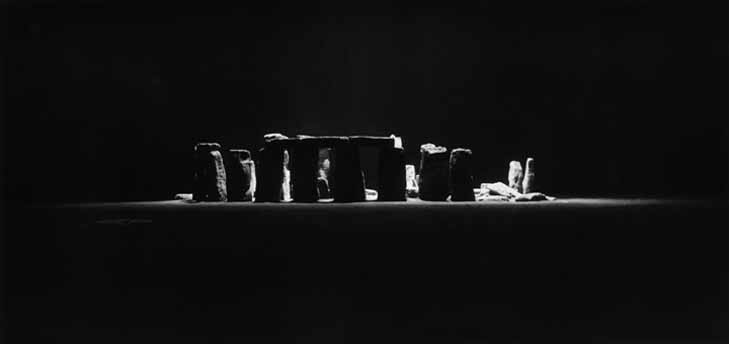
Actually, "henge" is a bit of a misnomer. MIT is more like the passage tomb at Newgrange or the temple at Abu Simbel
You can see a bit of the sky conditions at the sailing pavilion. Here.
More weather cameras. Here.
Read Alan Eliasen's explanation first , then read the MIT Planning Office explanation and watch this Video by Dan Falk. There is also a Wikipedia Page. Then come back here. Look at all the pictures and read the day-by-day descriptions.
Angular width of doorway from various distances
Sun altitude at azimuth 245.75 for 2016
Sirius altitude at azimuth 245.75 for 2016
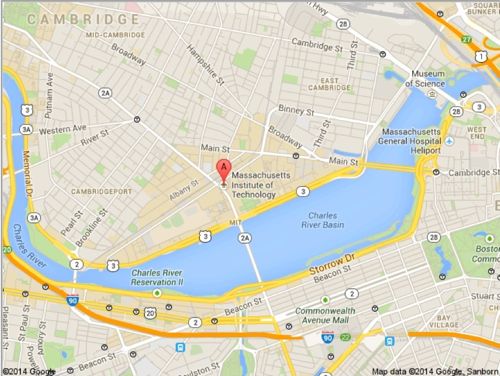
Location of 77 Mass. Ave.
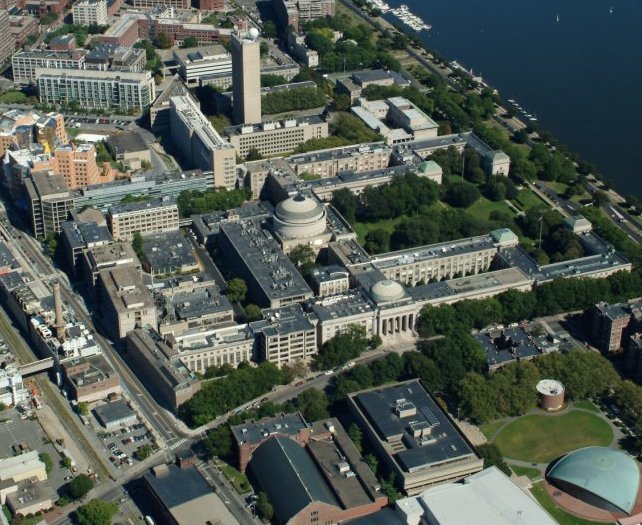
Aerial view. The big dome is Building 10 and the smaller dome
with columns in front is Building 7.
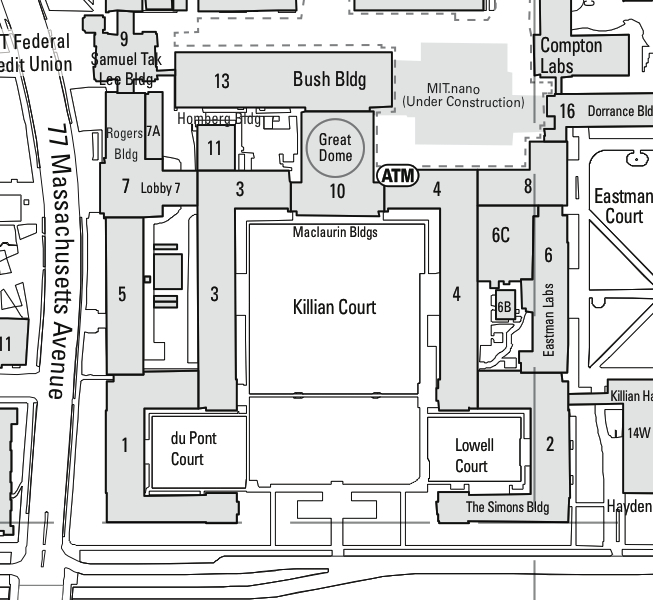
Building numbers.
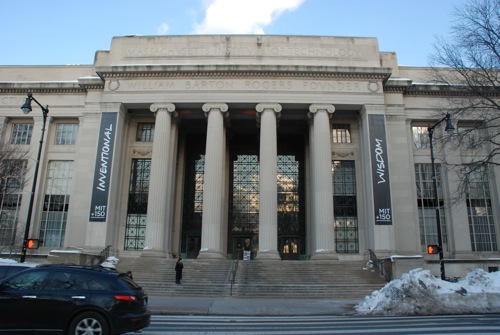
MIT Building 7 entrance, 77 Mass Ave.
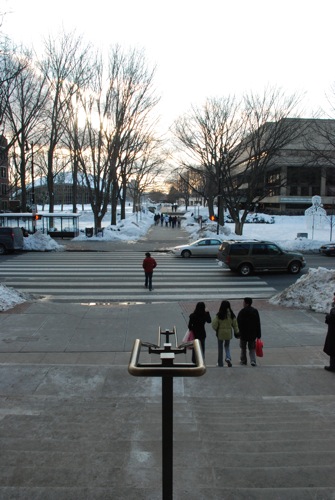
Looking toward the sunset from 77 Mass Ave.
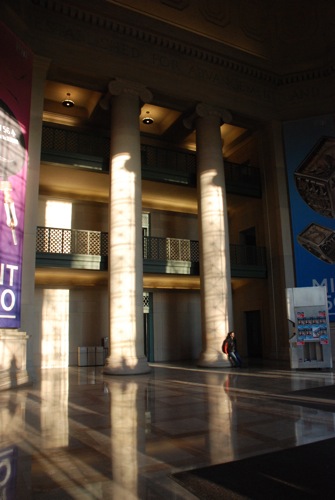
Building 7 lobby.
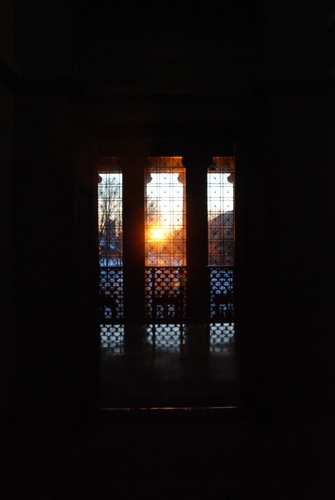
Sunset through the 77 Mass Ave. window.
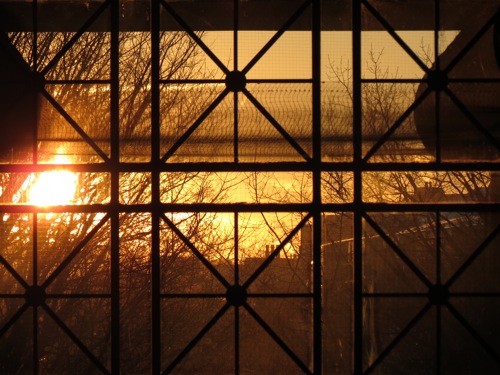
A closeup of the window shows the trees and buildings..
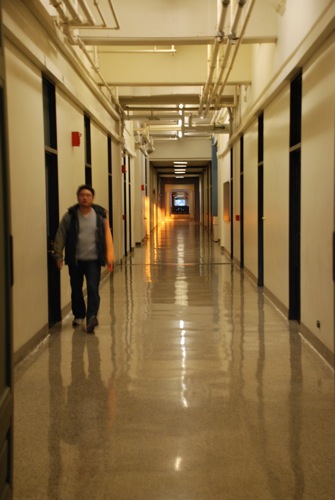
The sun shining down the Infinite Corridor.
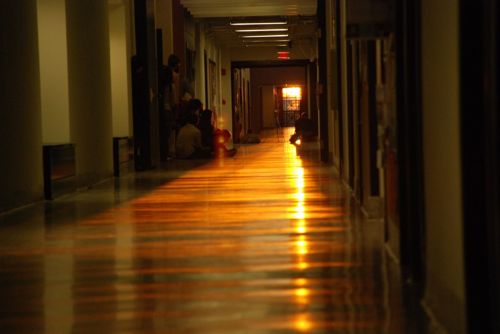
A much more dramatic picture.
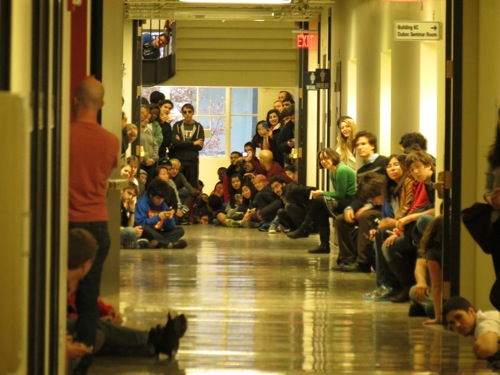
And did I say it was a big deal!
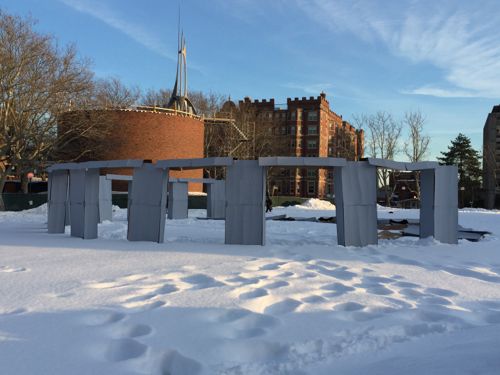
In January 2015 a big cardboard henge appeared on Kresge Plaza.
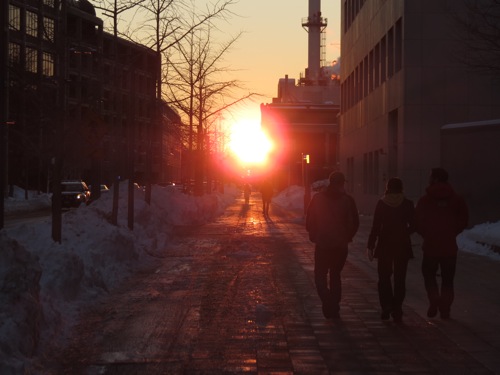
Another alignment at MIT. The Winter Solstice sunset down Vassar St.
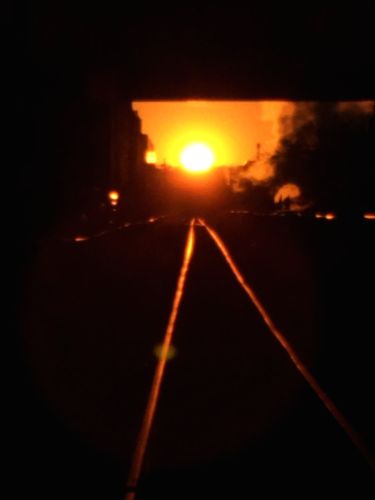
The railroad tracks also have a pretty good Winter Solstice alignment.
The campus is still closed.
A new video
The campus is still closed.
The campus is still closed.
Wednesday, November 11th: The campus is in lockdown due to the Covid19 pandemic. No Observing.
Wednesday, January 29th: Nice and clear. Pictures .
Thurssday, January 30th: I was unable to attend.
Friday, January 31st: Cloudy.
Saturday, February 1st: Cloudy.
Sunday, February 2nd: Not clear enough at sunset. Pictures .
Monday, February 3rd: Made a solar filter video from 2nd floor of Lobby 7. Pictures .
Friday, November 8th: Some clouds and leaves on the trees. Pictures .
Saturday, November 9th: No clouds but leaves on the trees. Pictures .
Sunday, November 10th: A bit cloudy so not very impressive. This was the first publicized day, so I couldn't stand in front of people. I set up at the Building 10 - Building 4 stairwell. I didn't see any disk so I didn't record the camera position. Pictures .
Monday, November 11th: Cloudy. Transit of Mercury also clouded out.
Saturday, January 26th: Clear sky but clouds on the horizon.
Sunday, January 27th: Cloudy.
Monday, January 28th: A bit of sun, then clouds. Pictures .
Tuesday, January 29th: Cloudy.
Wednesday, January 30th: Cloudy with a chance of balloons. Pictures .
Thursday, January 31st: Clear! Pictures .
Friday, February 1st: Clear again. I set up on the 2nd floor in Lobby 7 at the railing. Pictures .
Saturday, February 2nd: It was mostly cloudy with some breaks. I stayed at my IAP photo class today. Somebody who did go over to MIT Henge said that it was good.
Sunday, February 3rd: Just a quick trip to the 3rd floor. Pictures .
Monday, November 5th: Rain.
Tuesday, November 6th: Rain.
Wednesday, November 7th: First clear day this week. The sun is still a bit high and there are still leaves on the trees. I observed from the 2nd floor at the Lobby 7 railing. Pictures .
Thursday, November 8th: It was a clear day, but I wasn't able to get down to MIT. :-(
Friday, November 9th: Completely cloudy with rain and flood warnings for tonight.
Saturday, November 10th: It rained in the morning but cleared in the afternoon. I observed from the Building 10 and Building 4 stairwell area. I made a time-lapse video with the iPhone and a real-time video with the SX-40. I did not use the solar filter, so the real-time video is too bright to see the sun's disk. Pictures .
Sunday, November 11th: Clear again. I used the solar filter today for a real-time video. So many people were standing or walking in front of me that I didn't get much. :-( Pictures .
Monday, November 12th: Clear this morning but hazy in the afternoon. I thought that I might get lucky and see a disk of the sun through the haze, but it became completely cloudy. Pictures .
Tuesday, December 19th: Two days before the Winter Solstice. Weather forecast is bad for the next few days, so I decided to go down to Vassar St. today to watch the sunset. Pictures .
Thursday, January 18th: I was at MIT for a photography class and noticed a thin crescent moon. All I had was my phone camera. I stayed outside and lined up the two handrails in front of the Student Center. Pictures .
Saturday, January 27th: Cloudy.
Sunday, January 28th: Cloudy.
Monday, January 29th: I couldn't get down to MIT today and it was cloudy.
Tuesday, January 30th: Another day that I couldn't get down there, and it looked cloudy.
Wednesday, January 31st: A bit of henge today, but not completely clear. Pictures .
Thursday, February 1st: Couldn't get there today, but it was completely cloudy from home.
Friday, February 2nd: Groundhog Day. Partly cloudy during the day but it was clear at sunset. Probably one of the best days. I set up at the railing of the 2nd floor to do a video with the solar filter. I aligned the camera so that the center of the window lined up with the handrails in front of the Student Center. Pictures .
Saturday, February 3rd: Another good day, even though the sun was a bit high. Yesterdays video wasn't zoomed in very far so the sun was fairly small, and the window was somewhat out of focus since I was at the Lobby 7 railing and focussed at infinity. So I moved down the 2nd floor hallway back to the first stairway and put the camera in the center of the hallway, which I measured with a tape measure. I zoomed in all the way and used the solar filter. I also did a time-lapse down the hallway toward Building 10. Pictures .
Sunday, February 4th: Super Bowl Sunday, and it was raining.
Monday, February 5th: One last day. 2nd floor had a poster hanging there, so I tried to do a time-lapse of the sun crossing the window from next to the railing. The Sony video camera did not focus well with the solar filter on even though it was in manual focus mode. Pictures .
Wednesday, November 8th: Clear, but there were still a lot of leaves on the trees. After looking from the 2nd and 3rd floors, I thought that I wasn't going to see much from either of those locations. So I decided to do a time-lapse video in Lobby 7 looking toward the Infinite Corridor on the 1st floor. Pictures .
Thursday, November 9th: Wasn't able to get to MIT by sunset and it looked like it was going to be cloudy.
Friday, November 10th: It was clear again, so I felt a moral obligation to go to MIT and at least be there even though I thought that the leaves would be a problem. After looking from both the 2nd and 3rd floors, I decided that the 2nd floor would be better, even though the Lobby 10 balcony obstructed the full length. So I set up a bit in front of the Lobby 10 balcony and once again did a time-lapse video. I was surprised that quite a bit of sun made it through the leaves. I might have been able to photograph the suns disk but I wasn't really expecting to do that, so I wasn't prepared. The video gives a good impression of what MIT Henge is all about. Pictures .
Thursday, November 23rd: I found this article on the Infinite Corridor and MIT Henge on Atlas Obscure. Here .
Tuesday, December 19th: I made a time-lapse video of the almost Winter Solstice sunset on Vassar St. Pictures .
Friday, January 27th: Cloudy.
Saturday, January 28th: Cloudy.
Sunday, January 29th: Looked promising for a while. But turned out cloudy.
Monday, January 30th: Looked like it might be hazy, but it cleared up. I was at the east end of Building 10 on the 3rd floor. I made a time-lapse video. You can't see any sky when standing up at that location. You have to be near the floor to see any sky. There was a 15 degree high moon crossing at 6:28 PM, which we had to watch from the 1st floor. And we could see Venus and just barely see Mars through the windows. Pictures .
Tuesday, January 31st: Snow today.
Wednesday, February 1st: Clear until the last few minutes, then cloudy.
Saturday, February 4th: A nice clear day but I didn't take my camera gear when I went out for the day. So I got to MIT with only my cell phone. Nobody else was there. I took still pictures from each of the stairwells on the 3rd floor just to show the view. Since the sun looked like it was too high to shine down the 3rd floor, I went down to the 2nd floor and made a time-lapse video looking down the 2nd floor from Lobby 7. Pictures .
Tuesday, October 18th: Three weeks early. I happened to be at MIT and noticed that the sun was in the right position. Just about 4:52 PM. The sun was going part way down the corridor at this early date. Pictures
Thursday, November 3rd: A video by Misha Sra from January 31, 2016, courtesy of Yuri Pattison. Video
Monday, November 7th: Two days early, but the sun was about 1.5 degrees up so I thought it would be a good day with no crowd. I set up at the Lobby 7 balcony and tried to get a video through the solar filter. There were still a lot of leaves on the trees, but the sun did come through some openings. I don't know if the sun made it all the way down the hall, but it was at least 2/3rds down the corridor.. Pictures
Tuesday, November 8th: Another clear day. No crowd, so I set up in the middle of the corridor at the Building 4 and 10 stairwell. I took a normal video and a time-lapse video. Dr. Richard Binzel of the Earth and Planetary Science Department stopped by to see what I was doing. Pictures
Wednesday, November 9th: Cloudy.
Thursday, November 10th: The morning was clear but it clouded up during the day. I went down to MIT just in case there was a bit of clearing. It brightened up when the sun was between two bands of clouds, but in the end, nobody saw anything. There were a fair number of people there. Pictures
Friday, November 11th: Nice and clear. Big crowd. I did another time-lapse, but this time from eye level. It was windy today so a lot of the leaves on the trees had come down. You can see 640 Memorial Drive now. Pictures
Saturday, November 12th: A bit hazy today. The sunlight didn't seem as strong as on a completely clear day. Took another time-lapse. Had trouble getting the solar filter on and changing the camera settings. Pictures
Sunday, November 13th: Probably the last day of MIT Henge for November. Nice and clear. I decided that there were still too many leaves on the trees to get shots of the disk of the sun through the windows. So I thought that I'd try to get some outside shots to show how the sun was moving across a clear sky. So I set up in front of the Student Center and lined up with the handrails going up the stairs, which I believe are in line with the Infinite Corridor. Anyway, the sun went behind a tree and set short of where I thought it would go, due to my low viewing point and the distant obstructions. I did get some pictures through a solar filter and I'll try and combine them into one image at some point. Pictures
Saturday, December 3rd: Moon crossing today. Caught a couple minutes at the end. Pictures
Sunday, December 4th: Another moon crossing today. A couple of degrees higher than yesterday. I observed from the 2nd floor of Lobby 7. There was also a Mars crossing, but I thought that there would be no way to see that. Pictures
Friday, December 9th: I was down at MIT so I looked at the leaves. They are all down. Pictures
Tuesday, December 20th: Winter Solstice sunset down Vassar St.. Pictures
Wednesday, January 27th: One day early. It was partly cloudy today, but by late afternoon it was clearing, so I had to go down to MIT to see if anything would happen. The sun didn't quite reach the center line but the effect was pretty good. Only I and Elizabeth C. were there. I expect more people tomorrow. Pictures
Thursday, January 28th: Not completely clear. Couldn't see the disk of the sun. Pictures
Friday, January 29th: Clouds, rain and snow.
Saturday, January 30th: Horizon clear at sunset. Great view. I was down at Building 10-4 stairwell. I put the iPhone on the tripod and took a time-lapse video. To see the disk of the sun, I had to sit on the floor. So I took some still pictures with the solar filter on the SX40. Pictures
Sunday, January 31th: Another nice day. After yesterday, I thought the sun would be too high to see from farther back, so I went forward to Building 3 and had the camera close to the floor. So the sun was mostly behind the grillwork and somewhat too dark this time. Pictures
Monday, February 1st: Couldn't make it down there today. And it's pretty overcast.
Tuesday, February 2nd: Perfectly clear. Since it was after the predicted days, the sun was a bit higher and very few people were there. I set up right at the Lobby 7 railing to get a wider view. Took some video with the solar filter and a time-lapse pointed back down the hallway. Pictures
Saturday, February 6th: I was down at the MIT Museum for a talk by artist Arthur Ganson. There was some nice color st sunset, but I couldn't get over to MIT Henge before sunset. I did go over and take some pictures to illustrate the various observing locations on the 3rd floor. Pictures
Sunday, February 7th: It looked like it might be clear, so I went down to MIT. The sun was a bit too high to see from the 3rd floor so I went down to the 2nd floor today. I set up the camera so that the center frame of the window was directly in line with the handrails in front of the Student Center. When I dropped a plumb line, it was directly on the brass strip in the floor, which confirms my suspicion that these things are aligned. I don't know if that alignment continues all the way down the corridor. Pictures
Monday, February 29th: Three weeks after MIT Henge and the sun still shines down the corridor. Didn't get there for the axis crossing, but the sun was just over the Student Center. And there was some strange random birthday celebration in Lobby 7 with a rendition of the Barbarian Birthday Song. Pictures
Saturday, March 5th: I wanted to see if you could still see the sun cross the window. But it was cloudy amd I think the sun is now too high to be seen from the 2nd floor. I did make a time-lapse video of people in Lobby 7. Pictures
Sunday, December 20th: The Winter Solstice is two days from now, but the suns declination hardly changes by then. Since it was clear and it's Sunday, so parking is easier, I went down to MIT to see the Winter Solstice sunset down Vassar Street. Pictures
Friday, December 25th: Went back to Vassar St. since there was a possibility of a clear spot at sunset, but it was pretty cloudy. The full moon rise from Robbins Farm Park in Arlington later that evening was better. Pictures
Monday, November 16th: There was a moon crossing at 8:40 PM tonight. The alignment was perfect. Pictures
Mother Nature didn't check the MIT Henge schedule before she delivered 3 days of clouds and rain.
Sunday, November 8th: I went down to MIT to look at the leaves on the trees. I was not able to stay for sunset. There are still leaves on the trees. Pictures
Monday, November 9th: After being crystal clear all day it clouded up just as the sun was crossing the window. It may rain for the next three days. Pictures
Tuesday, November 10th: Heavy clouds.
Wednesday, November 11th: Rained all day.
Thursday, November 12th: Rained all day.
Friday, November 13th: Sunny to partly cloudy to cloudy during the day. I went down to MIT and saw just a bit of sun at sunset. Pictures
Saturday, November 14th: The day started off rather cloudy but cleared late in the afternoon.. The good alignments have ended, but it was clear and I thought that I would see at least something. Pictures
Monday, July 27th: There was a moonset alignment early this morning at 1:50 AM. It was raining. There will be another moonset alignment at 4:30 AM on Thursday, July 30th. I went down to MIT this afternoon to see if the leaves on the trees would block the view. Yes, they will. The view is completely blocked. Pictures
Thursday, June 18th: An article in The New York Times about the skylight at the Fulton Center Hub. Here
Monday, July 13th: Manhattanhenge is happening again. Here
Monday, Jan 12th: I went down to MIT to see if there were any leaves still on the trees. All the leaves are gone, but there are a lot of branches in the view. Pictures.
Friday, Jan 23rd: I was at MIT for an IAP photography class. Venus was in the Western sky close to the MIT Henge sunset azimuth. Pictures.
Wednesday, Jan 28th: Today was the day after the blizzard. There is a snow emergency in Cambridge, so there is no on street parking at MIT. The West Garage was open and free today so I parked there. MIT seemed to be closed due to the snow. It started off cloudy but cleared nicely during the day. Just one other person besides me seemed to know that MIT Henge is starting. I observed from the Building 4 and Building 10 stairwell area. I used the iPhone to make a Hyperlapse video and took some still pictures. I am reminded that from that location, you can't actually see any sky while standing up. After sunset, I waited an hour until Venus crossed the window. It was high enough that I had to look from the 2nd floor balcony of Lobby 7. Venus was easy to see through the window, but you have to deal with reflections and it's hard to tell when it crosses the centerline. I made a 3 minute video of Venus. Pictures.
Thursday, Jan 29th: The sun went behind the clouds at the last minute. There were a lot more people there today. I talked to a bunch of folks at the balcony end of the corridor and did some educating. Out on Kresge Plaza was a big cardboard henge. It wasn't there yesterday. Pictures.
Friday, Jan 30th: Cloudy with light snow.
Saturday, Jan 31st: Perfect weather. I took a break from my photography class. I tried an experiment. I was in Building 3 close to Lobby 7. I used a solar filter and tried to make a video of the sun actually crossing the window. It didn't work very well because the camera was on the floor so it ended up looking through the railing rather than over it. I had expected a high and to the right sun passage. Pictures.
Sunday, Feb 1st: Another day when the sun went behind the clouds at the last minute. When I got there today, I discovered that a Pirate Bay banner had been hung in Lobby 7 so that it blocked part of the view from the 3rd floor. I measured the distance from my camera position yesterday to the balcony railing. It's 87 feet and the railing is 45 inches high. This is to compute the angle that the railing blocks. At henge time I went to the 2nd floor railing, but it clouded up before the alignment happened. Pictures.
Wednesday, Feb 4th: A somewhat inaccurate article in Atlas Obscura. Here.
Friday, Oct 24th: I was at MIT so I scouted out the current conditions. There are still a lot of leaves on the trees, blocking the view. And there is some construction going on in the Infinite Corridor so there are some obstructions in the hallway. Of course, things could improve by November 11th. Pictures.
Sunday, Nov 9th: It's a day or two early, but Alan Eliasen thought that Venus might be visible. And since the sun would be slightly higher and the weather was pretty good, I decided to go down to MIT and observe. It was almost impossible to find a place to park. Don't know why. There were some clouds on the horizon and still leaves on the trees, so the sunlight wasn't very strong. I was the only person on the 3rd floor, so I stood right at the railing of Lobby 7. As far as I could tell, there wasn't much light shining down the hall. The obstructions that were in the corridor a couple weeks ago seem to be gone. Pictures.
Monday, Nov 10th: First day with a predicted good pass.
I thought that it was a bit hazy. There was sunlight coming down the corridor.
I tried taking a time-lapse movie using Hyperlapse on the iPhone 5s.
Pictures and time-lapse.
More Pictures.
Tuesday, Nov 11th: Today was a complete mystery, at least to me. I decided not to observe from down the hall at Building 4. So I set up much closer to Lobby 7 near the Building 3 hallway. So I waited and didn't see much of anything. Nothing that looked like the sun through the windows. J and L were there. J was at Building 4 and thought that today was actually brighter than yesterday. L was at the far end of the hall and thought that today was not at bright as yesterday. Why both J and L saw fairly normal things while I didn't see any light going down the corridor is completely mysterious. Pictures.
Wednesday, Nov 12th: I decided to observe from outside. So I set up at the first handrail going up the stairs in front of the Student Center. I took a 3 minute video with the solar filter before the sun went into a cloud bank. Pictures.
Thursday, Nov 13th: Cloudy.
Sunday, Dec 14th: It's only a week before the winter solstice and it was clear, so I decided to go down to MIT. First, I was slightly confused as to whether I should be on Vassar St. or Albany St. The answer is Vassar St. Then I had a hard time finding a place to park. Then some engines came down the Grand Junction tracks so I had to video them. Then somebody asked me where the MIT swimming pool was. Then I set up on the north side of the street and the sun immediately started going behind a building. Then I forgot to lock the tripod so the camera moved around so I couldn't get a picture without the solar filter that matched the video with the solar filter. I think that a better location is on the south side of Vassar St, just where it turns a bit. That allows you to sight right down the white line next to the curb, which should parallel the center of the street. Pictures.
Monday, Dec 15th: It turned into a nice day and I was in Boston around 3:00 PM, but I didn't have any of my camera equipment. But I decided to go over to MIT anyway and see if there were better vantage points on Vassar St. than I was using yesterday. I did have my cell phone camera. So I looked down Vassar St. and the railroad tracks and waited for the sun to get lower. The sun was a bit high over the end of Vassar St. and I think the azimuth is about 236 degrees. At the railroad tracks, when the sun finally went into the trees, it was about one diameter to the right of the tracks. This will only change a little bit for the real solstice. Pictures.
Thursday, Dec 18th: An article in Universal Hub about streets that line up with solstice sunrises or sunsets. Article. And the Map. And the original Article with a list of cities.
Thursday, May 29th: Manhatten Henge is today. NY Times Blog Article
Thursday, July 10th: Manhatten Henge is happening the next couple of days.. USA Today Article
Monday, July 14th: CNN Manhatten Henge Video
Tuesday, Jan. 7th: Alan Eliasen has updated his predictions to include 2014 and 2015. Here.
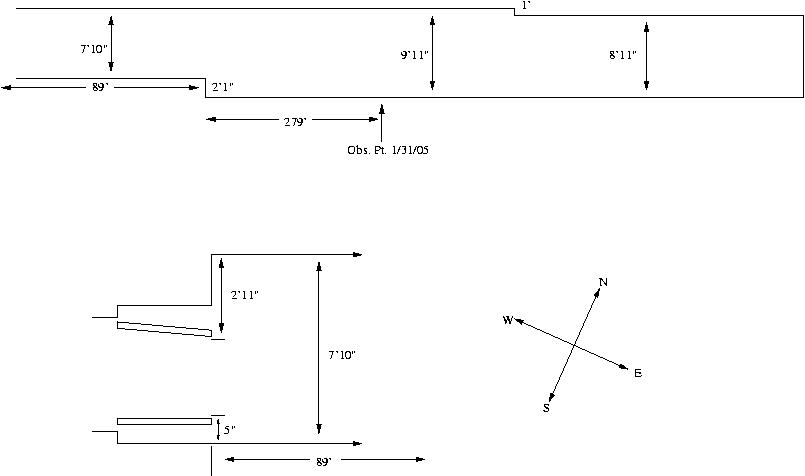
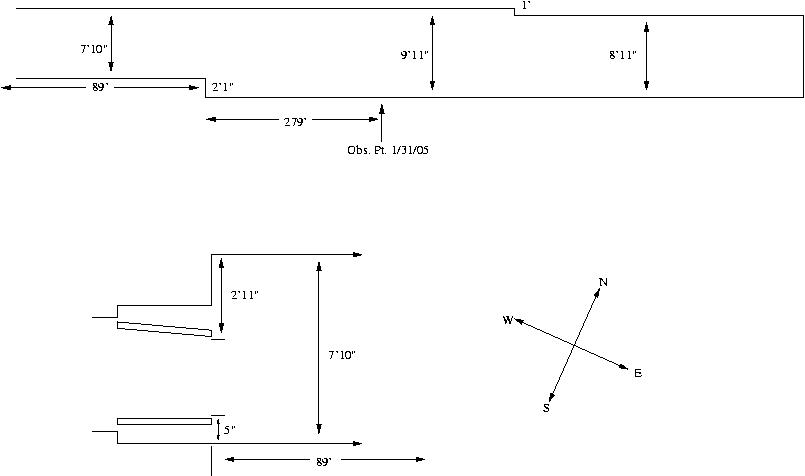
Saturday, Jan. 25th: Here is a diagram that Ken Olum made of the geometry of the corridor 3rd floor. Note that the doorway at the west end of the corridor is only 54" wide (4 ft 3 in). Drawing
Sunday, Jan. 26th: Cloudy.
Monday, Jan. 27th: Cloudy.
Tuesday, Jan. 28th: Cloudy. Pictures
Wednesday, Jan. 29th: First clear day after three cloudy days. I put the camera on the floor and took a video. Pictures
Thursday, Jan. 30th: Another clear day. Today, I went to the second floor, fastened the camera to the Lobby 7 balcony railing and took a video through the solar filter. Pictures
Friday, Jan. 31st: On and off clouds all day. Late in the day, it looked like there might be some sun at sunset, but it clouded up completely about 10 minutes before sunset.
Saturday, Feb. 1st: Another on and off cloudy day. Cloudy at sunset but some pink sky. Pictures
Friday, Nov. 8th: 2 days early. The sun would be a bit too high to shine all the way down the hall. There were a lot of clouds during the day and even a few raindrops. At sunset, there was a band of clouds near the horizon but seemed clear underneath. There were still leaves on the trees. JB and I got there and first looked at the view from the 2nd floor and then went up to the 3rd floor and observed from the railing of Lobby 7. Nobody else was there. We did see the sun cross the window and tried taking some hand-held pictures with and without a solar filter. There did not seem to be a strong light-down-the-hall effect. Pictures
Saturday, Nov. 9th: 1 day early. I was not able to get to MIT today since I had to be a TA at a blacksmithing class. JB did get there and reported that it was a lot like Friday. She observed from the Building 6-8 junction.
Sunday, Nov. 10th: Like Friday, it was cloudy with a clear band below the clouds. So at the appointed hour, there was actually some sun shining down the hallway. There were more people there today but it wasn't too crowded. Pictures
Monday, Nov. 11th: The sun went behind a cloud at the last minute. Pictures
Tuesday, Nov. 12th: I was not able to get to MIT today or the days following due to having to travel to California. JB reports that nothing was seen on Tuesday.
Saturday, Dec. 7th: Went down to MIT to watch sunset down Vassar St. Stellarium says that at 3:53 PM the sun's azimuth was 236 and altitude was 3. Pictures
Wednesday, Dec. 18th: The Winter Solstice is three days away. It was clear. The sunset alignment down Vassar St. was quite good. I have gotten a solar filter for my SX-40 camera. Pictures
Wednesday, Dec. 25th: The Winter Solstice was four days ago. It was clear today but clouded up by the time I got down to MIT.. I was going to check out the view down the railroad tracks. I did check out the view from the pedestrian bridge at the West Garage. Pictures
----------
I've been given a pointer to the Suncalc web page, which can be used to look for sun alignments. Suncalc
Two explanations of why the earliest sunset is not on Dec. 21.
Atlantic Magazine
Larry Denenberg
Friday, Jan. 18th: 9 days early. I was down at MIT this afternoon so I decided to stay until sunset and try out a new Canon SX-40 camera. The sun set somewhat south of where it will be during the alignment. Pictures
Sunday, Jan. 27th: This was the first day that was predicted to have the sun crossing the window, although at the bottom left-hand corner. Since nobody else was there and it didn't look completely promising, I observed right from the railing at Lobby 7 rather than going down the hallway. I mounted the Canon SX-40 right on the railing and took a 12 minute video. At first, as the sun cleared the column to the left of the window, sunlight started to advance down the north wall of the hallway. Then it seemed to just fade away. I don't know if this was because the sun had actually set behind the buildings and hills on the horizon or if there were some clouds out there. It did seem like there might have been some clouds. This happened a few minutes before the predicted sunset. The result was that nothing much was seen today. Pictures
Monday, Jan. 28th: Cloudy with snow.
Tuesday, Jan. 29th: Cloudy. I wonder how they feel at Stonehenge when it's cloudy on the summer solstice.
Wednesday, Jan. 30th: Warm and cloudy with drizzle.
Thursday, Jan. 31st: Rainy in the morning, clearing nicely during the day and then just enough clouds at sunset so prevent us from seeing anything. I also checked out Vassar St. and the railroad tracks behind MIT. They are aligned pretty close to the Winter Solstice sunset, so that will be worth observing sometime. Pictures
Friday, Feb. 1st: Thick cloud at sunset. Pictures
Saturday, Feb. 2nd: Cloudy.
Note: There is a moon crossing on Sunday, Feb. 3rd about 10:30 AM in the morning. The moon will be at last quarter phase.
Sunday Morning, Feb. 3rd: Guess what? Cloudy and snowflakes!
Saturday, March 23rd: Stopped by MIT to look at the windows again, trying to see just how much sky you can actually see. Look at the three vent stacks on the building in the distance and you can see that you can't see much sky above them. The field of view is very small. Pictures
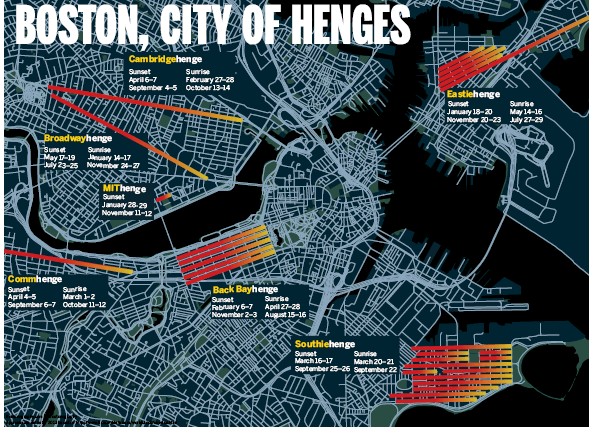
Sunday, April 7th: John Sheff reports a sunset alignment with Cambridge St. in Cambridge. It also happens around Sept. 4-5. And also an alignment with Broadway around May 17-19. The Feb. 3rd Boston Globe article also mentions these alignments.
Sunday, May 30th: ManhattanHenge was yesterday. Info here. and here, and Wikipedia.
Sunday, July 12th: ManhattanHenge is happening again. Info here.
----------
Slice of MIT 1/28/2013 - How Building 7 got built.
The Feb. 3rd Boston Sunday Globe had an article that mentions MIT Henge and other solar alignments in Boston and Cambridge. Here is the MAP. The whole article as .pdf (2.9Mb) is HERE.
The Washington Post had an article about Manhattan Henge on May 30, 2012. HERE.
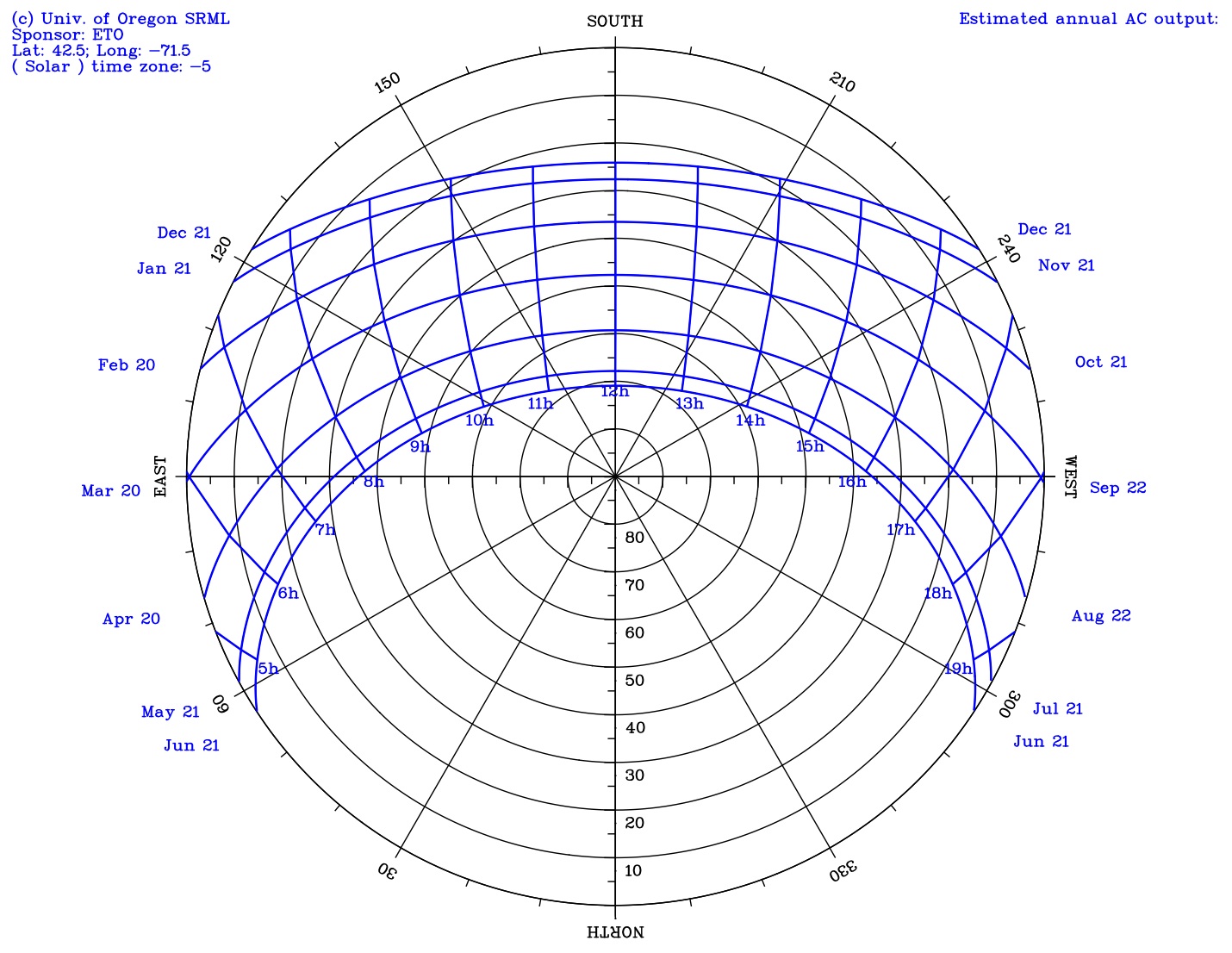
Various web sites can generate a sun path diagram. Here is a diagram that shows where along the horizon are the sunrise and sunset points during the year. HERE. This chart was generated HERE
An interesting app that uses Google Maps to show the direction to the sun is HERE.
Saturday, Nov. 3rd: I went down to MIT to photograph the Lobby 7 windows from different distances down the hallway, from the Lobby 7 railing all the way down to the far end. The pictures are Here
Using the pictures of the windows from various distances and a picture of the sun through some clouds, I put together this page showing how the size of the sun compares to the size of the window ar various locations down the hallway. The doorway at the west end of the 3rd floor hallway is only 54 inches wide, so from the far eastern end of the hallway, the doorway is smaller than the width of the sun. Pictures
Sunday, Nov. 4th: Since it looked like it would be clear, I went down to MIT for the sunset even though it is 6 days before the predicted best date. The sun was higher than it will be next weekend and didn't shine all the way down the 3rd floor hallway, but the effect is close to what it will look like next Saturday. Pictures are: Here
Friday, Nov. 9th: Nobody was there since it wasn't a predicted day, but the alignment was good. Pictures
Saturday, Nov. 10th: Pictures
Sunday, Nov. 11th: We didn't see much today. The sun started to shine down the right side of the hallway, then seemed to stop. We don't know if it went behind a cloud or the predictions were off. We need a spotter or camera outside to tell us what's going on. Pictures are: Here
Monday, Nov. 12th: Cloudy. Pictures
A video that I found on YouTube.
A video from MIT by Dan Falk. It's a good explanation of the event.
An article about Manhattanhenge at MSNBC.
The Wikipedia article on Manhattanhenge
Slice of MIT 1/27/2012 - Celebrate MIThenge
Pictures from January 29, 2012.
Boston Globe article from 11/12/2011 As PDF
Slice of MIT 6/30/2011 - How MIThenge Got Its Start
A short video from MIT Multimedia
The Sky & Telescope web article of January 27, 2011 As PDF
Full Sky & Tel article from November 2003 (PDF)
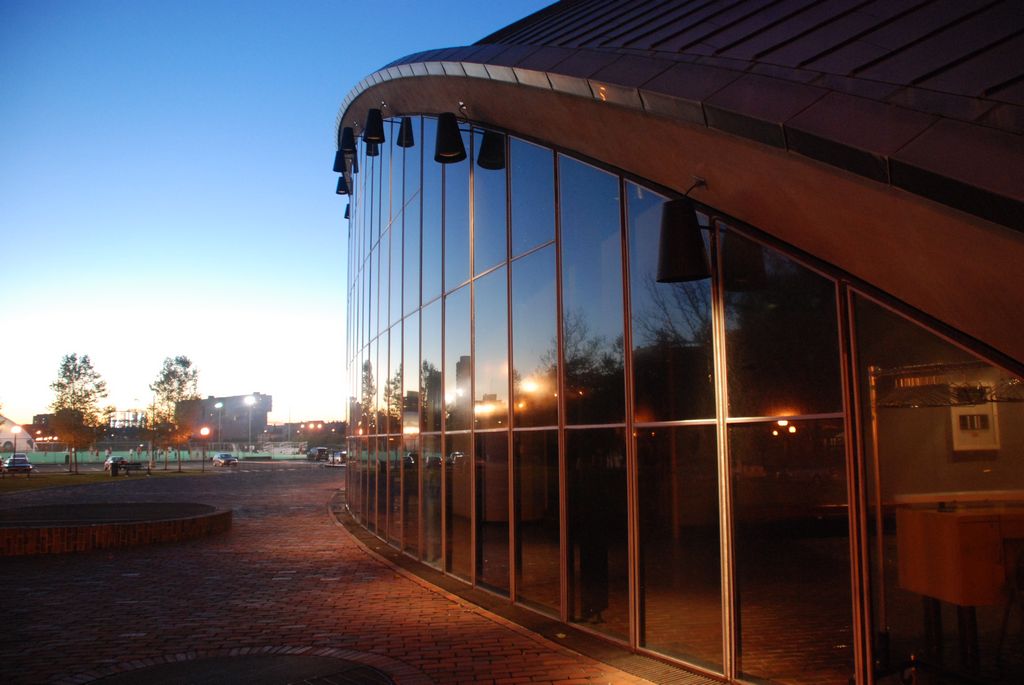
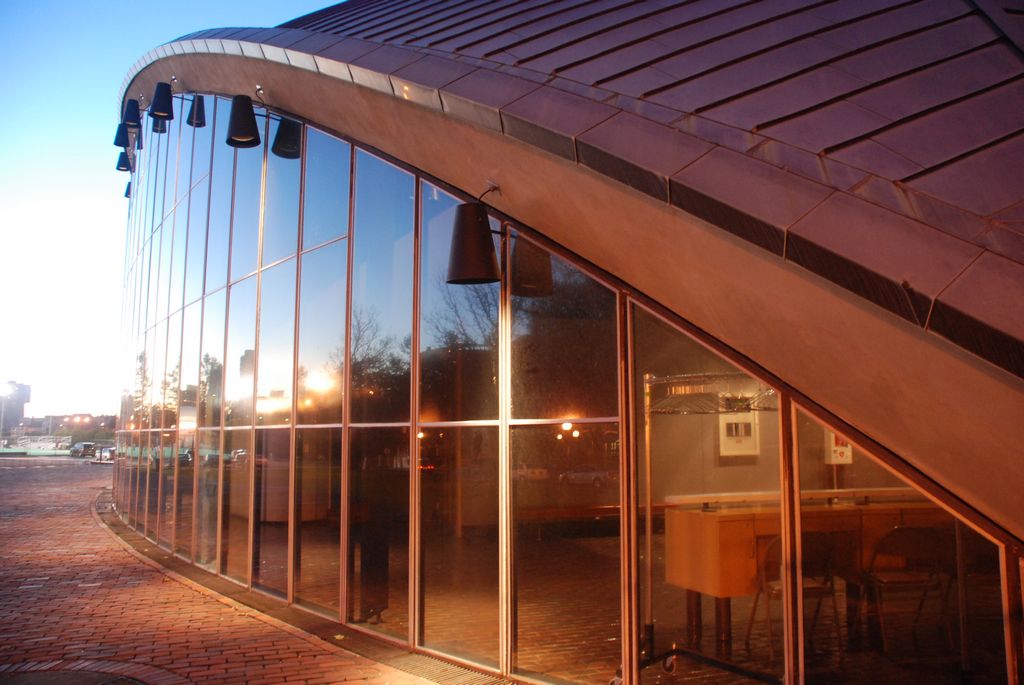
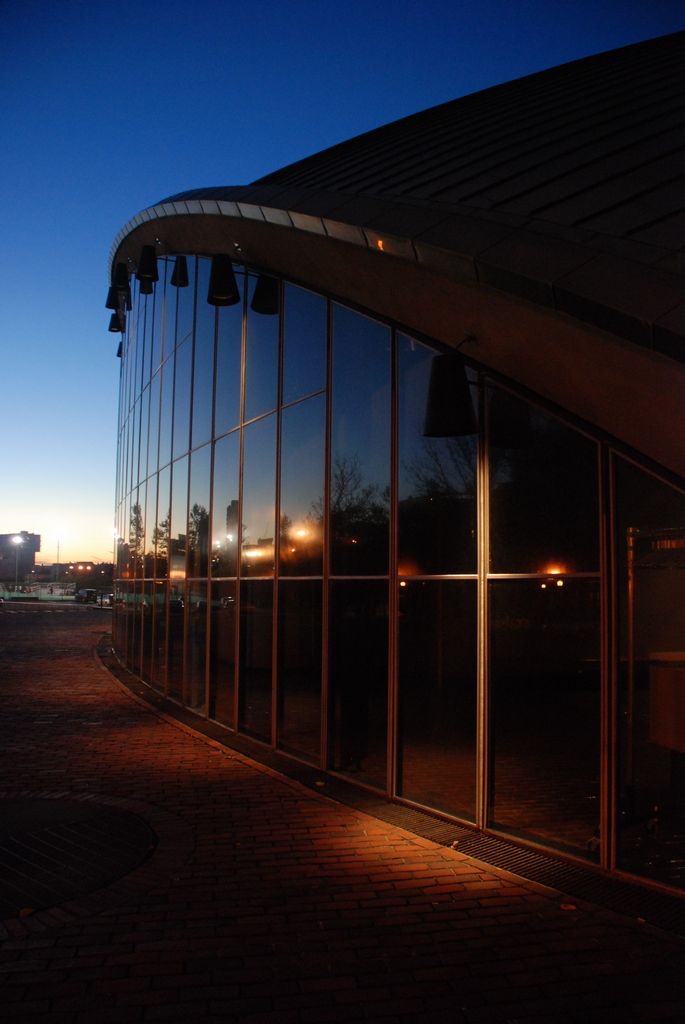
When I first started researching MIT Henge, I was frustrated by having to search for the information in different places. So I decided to centralize everything that I found in one place, this web page. After building the page in 2007, I realized that I didn't have any pictures of the outside of the building or of the horizon where the sun was setting. I have tried to add those pictures now, in January of 2011.
Twice a year, the sun aligns with the Infinite Corridor at MIT at sunset. Since the orientation of MIT does not line up with the winter or summer solstice, there are two dates during the year that this happens, around January 30 and November 11. By coincidence, these dates are near the Cross Quarter days of Samhain and Imbolc (Groundhog Day). As a side note, for Boston, Groundhog Day is the first day on which the sun has not set by 5:00 PM, so it is still daytime at the end of the work day.
The best technical details are here: This paper by Alan Eliasen
Other information is here:
See what the Clear Sky Clock says
The MIT Planning Office web page
The complete prediction table by Ken Olum
Stuart Goldmans 2003 article from Sky & Telescope (pdf)
A November 2005 email from Alan Eliasen
Wikipedia article about the Infinite Corridor
What does the planetarium program XEphem say about where the sun is? Note that the lat-lon is generic Cambridge.
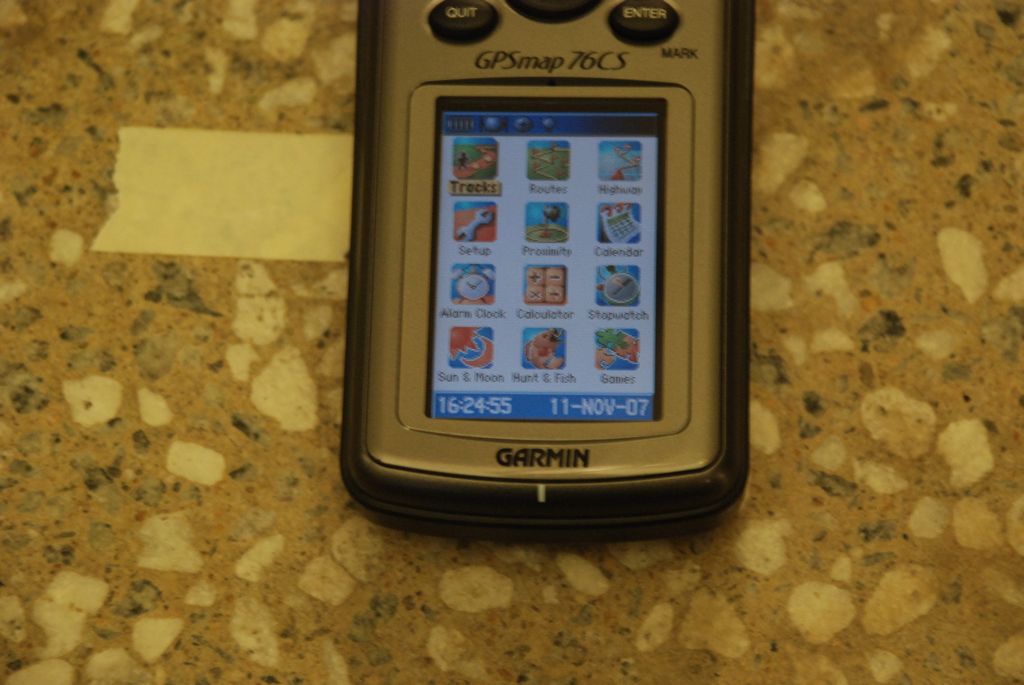
At 16:20:10 PM on 11/11/07 xephem gives the following values using the coordinates 42:22:01, 71:06:22, elevation 6.1 meters, temp 10.0 C, pressure 1010 mB.
RA 15:06:09.27, Dec -17:28:11.0, Az 245:44:33, Alt 0:41:09, rise 06:29, set 16:27
For some information on atmospheric refraction, see: this web page
For information on safe solar observing, see:
Fred Espenaks solar eclipse web site at NASA.
Scroll down to the section on "Safe Eclipse Viewing and Photography".
A couple of other interesting places with solar alignments are: Newgrange and Karnak
If your interest in MIT Henge extends to sundials, investigate the North American Sundial Society or the Sundial mailing list
Will it be clear? Look at the Clear Sky Clock.
Sunrise and sunset from Time and Date . com
Sunrise, sunset and sunpath from GAISMA
Sun and moon data from The U.S. Naval Observatory
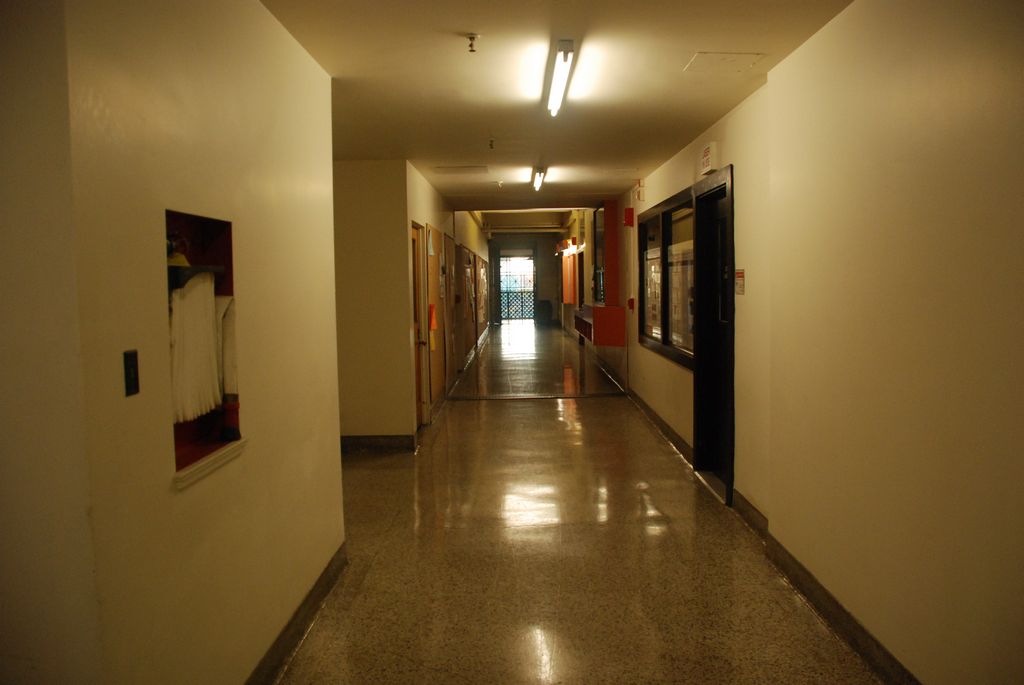

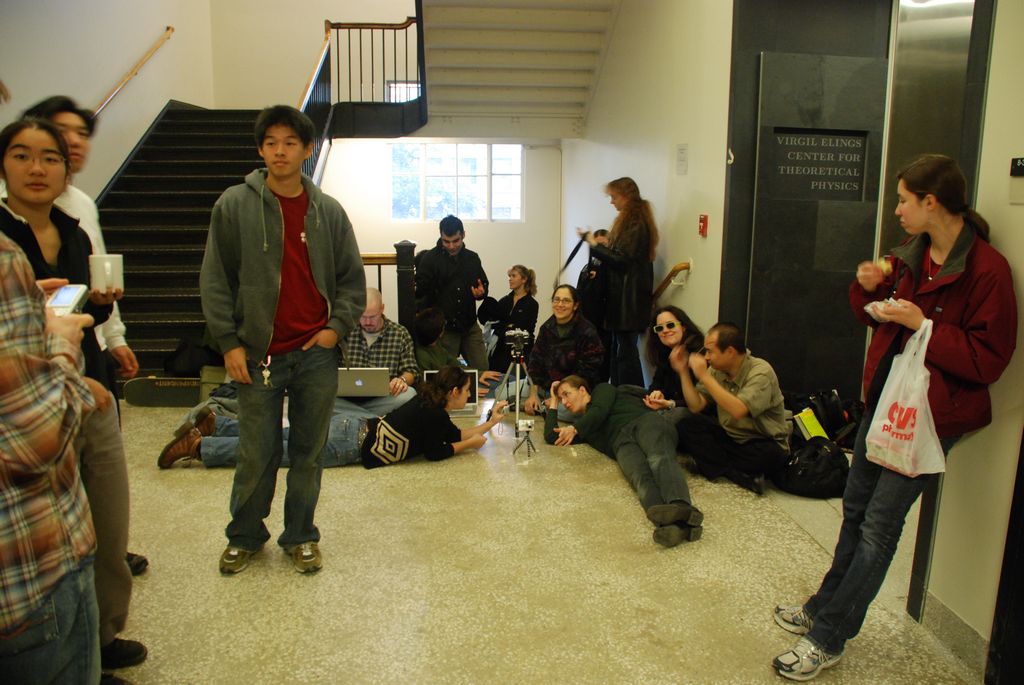
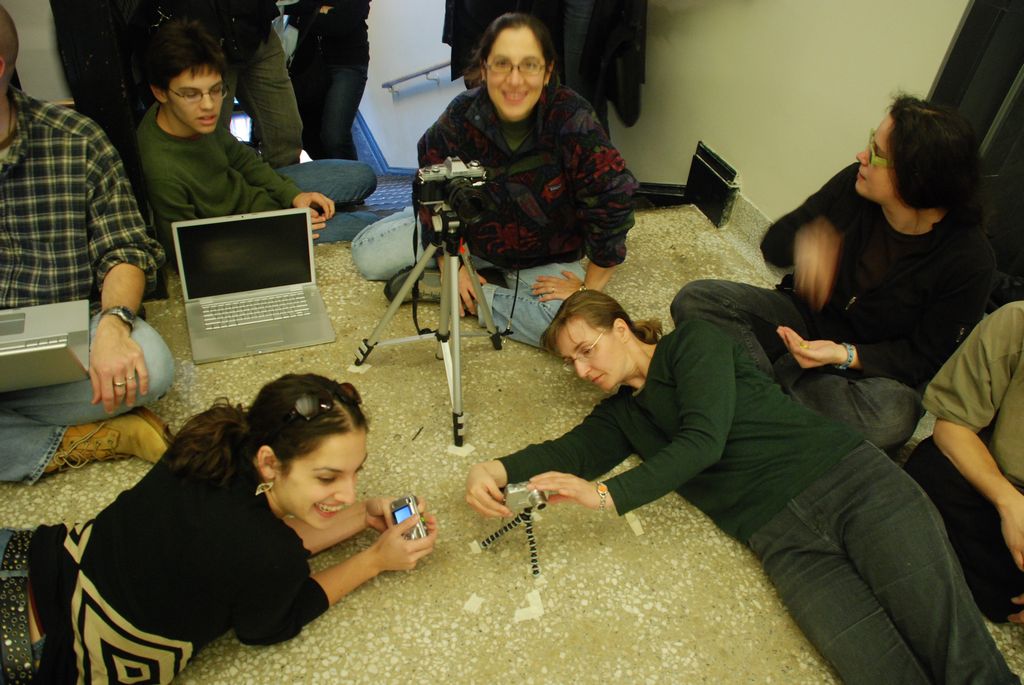
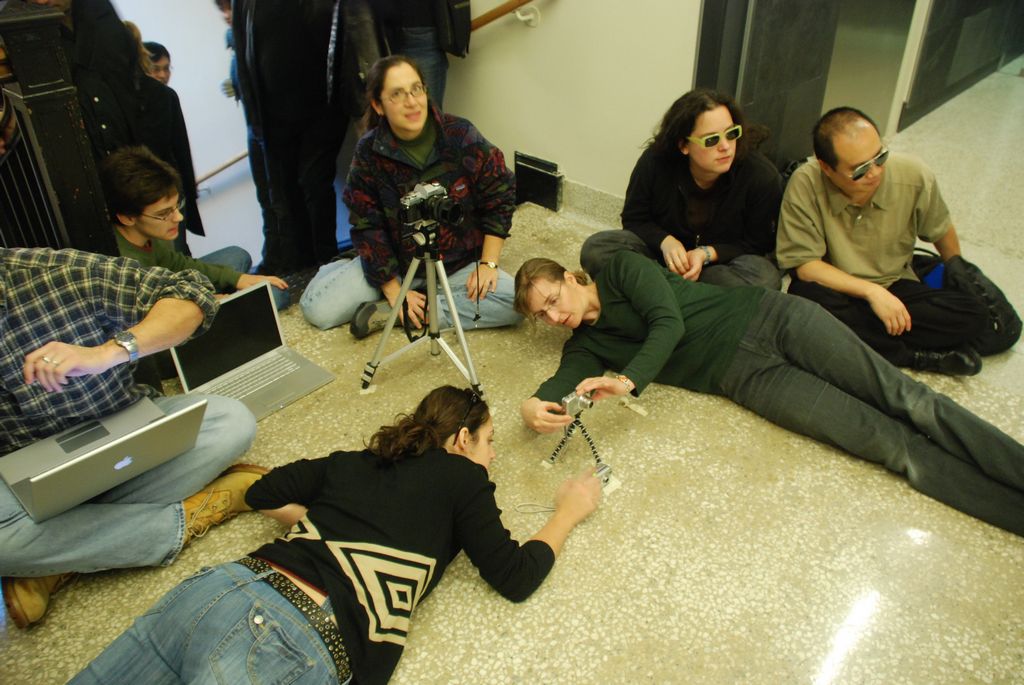
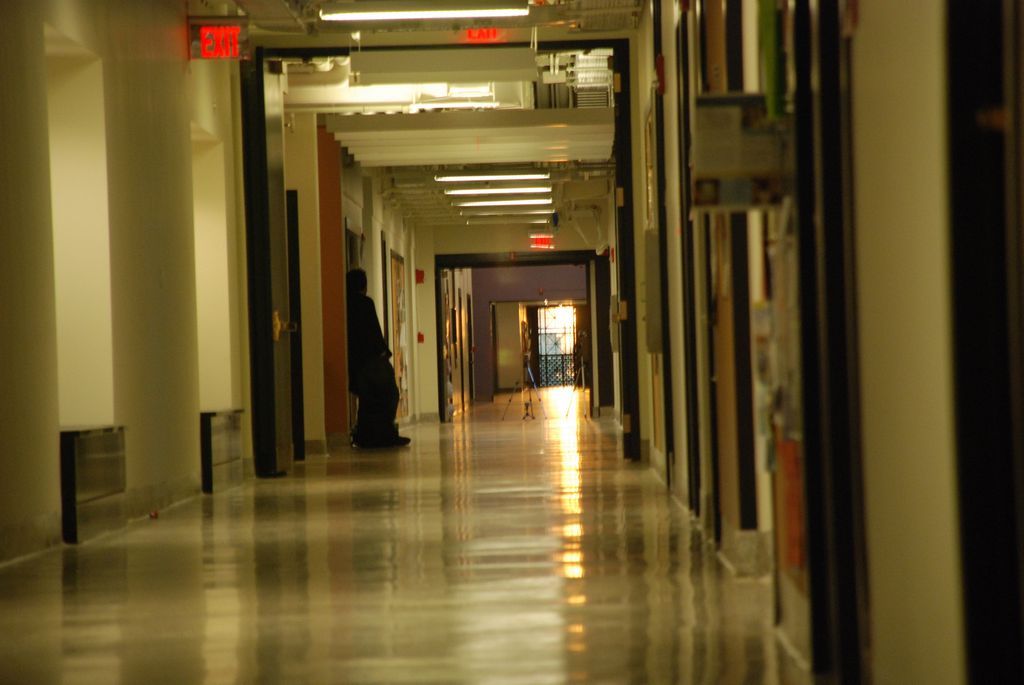
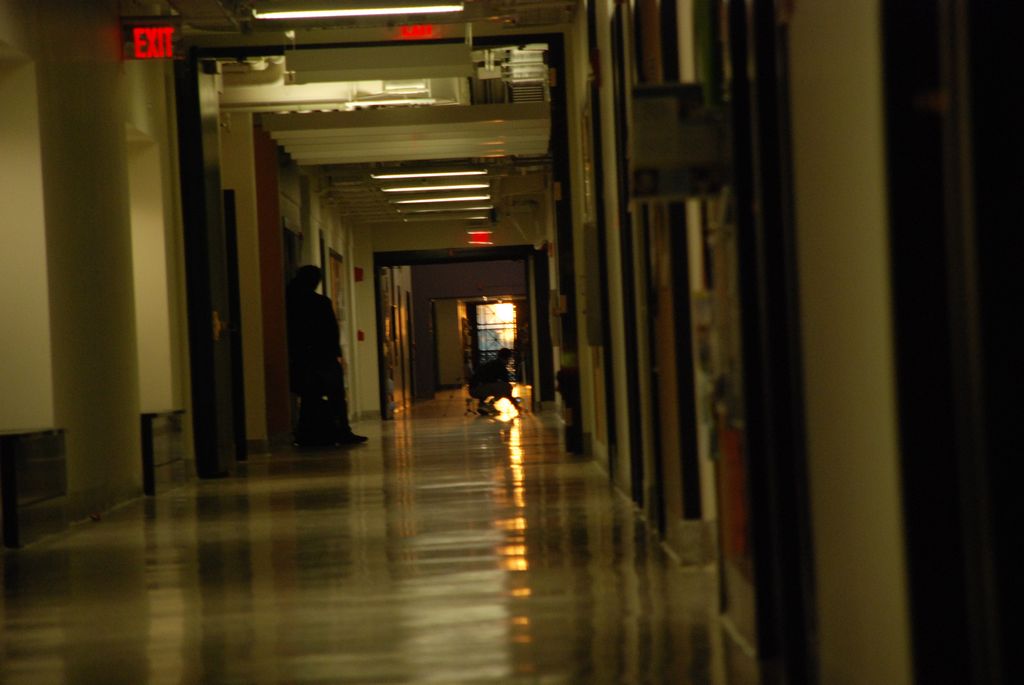
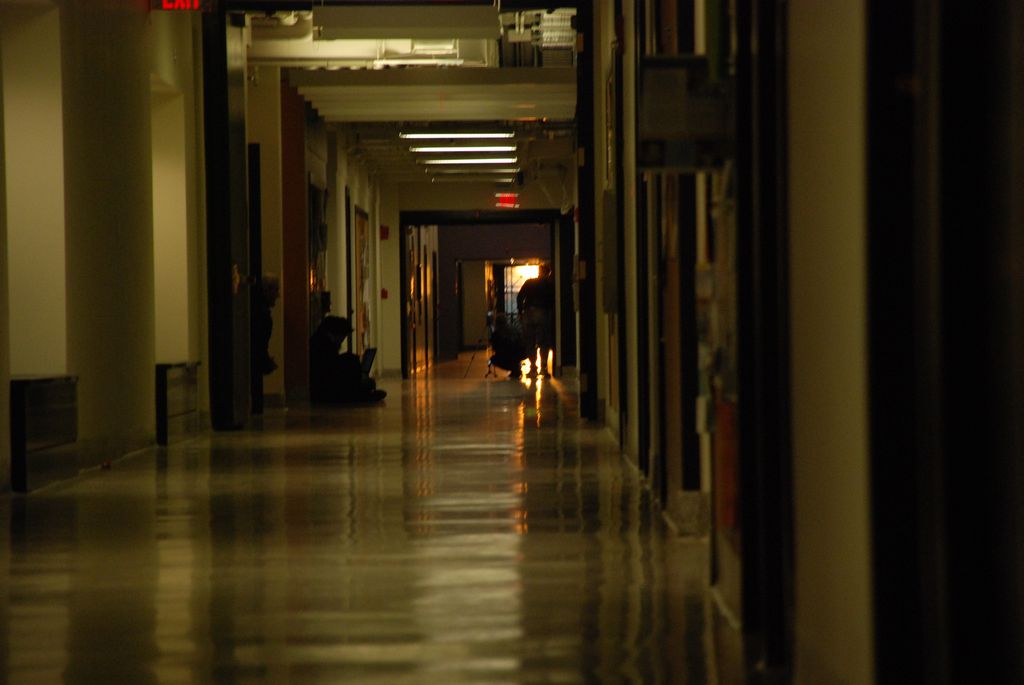
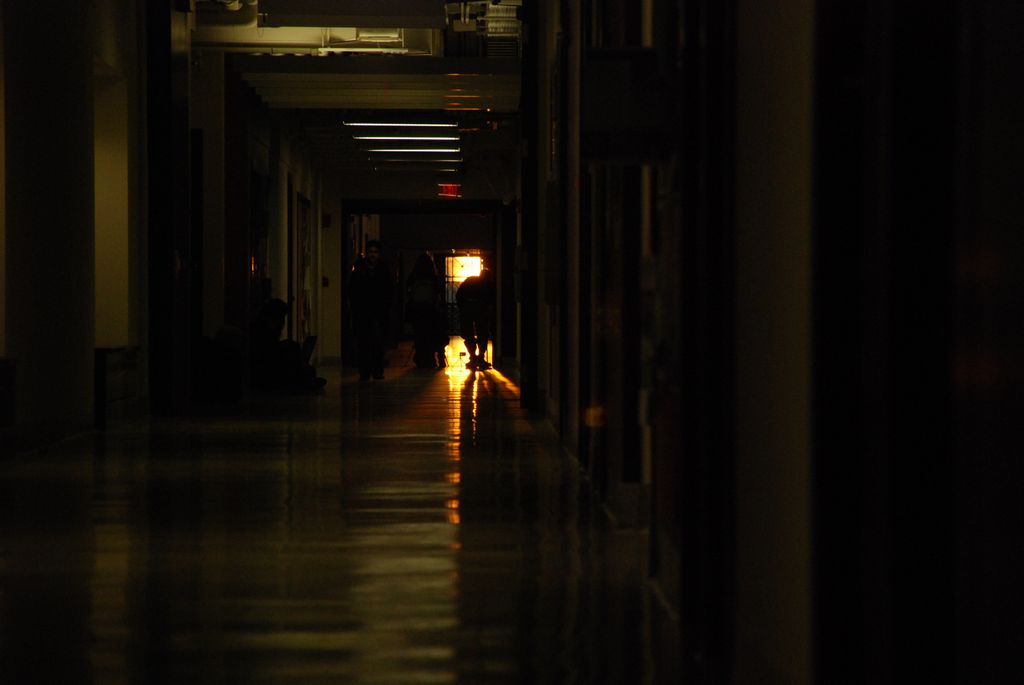
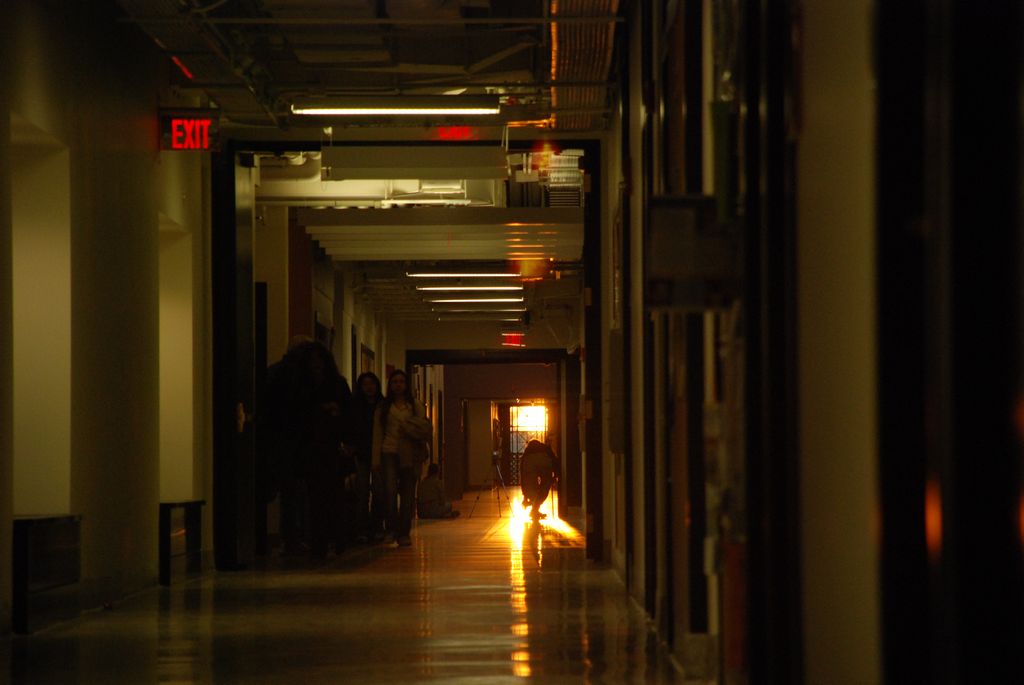
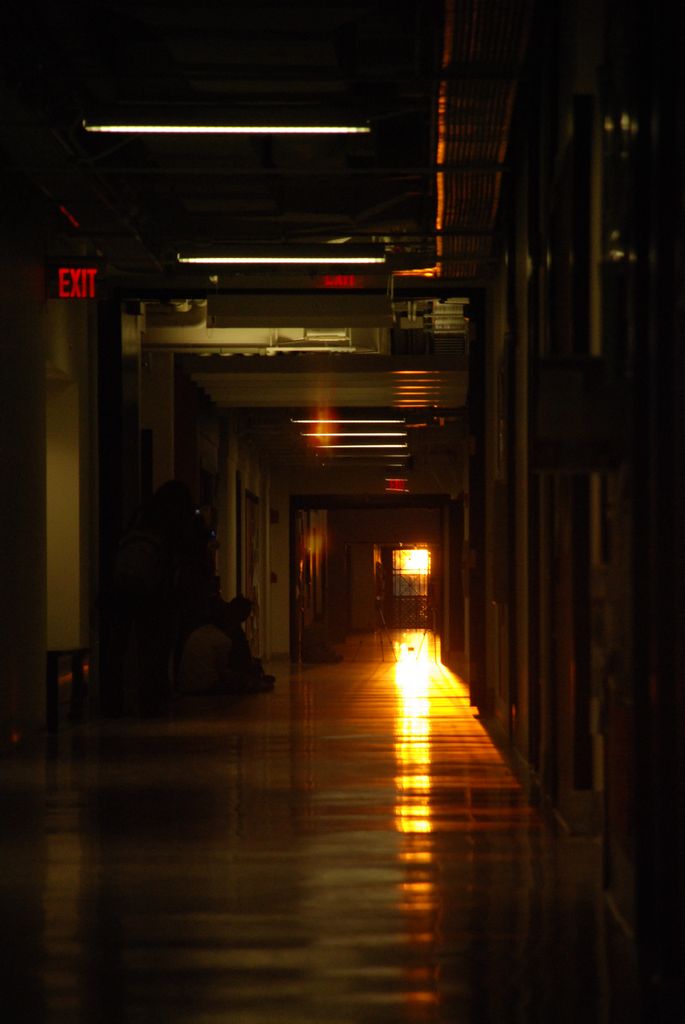
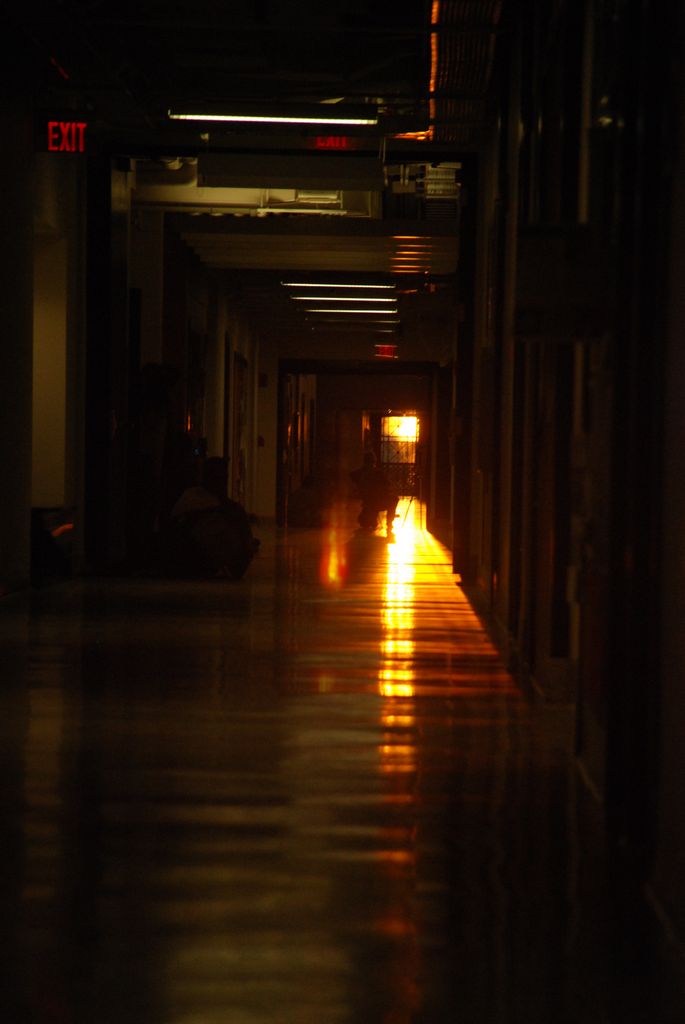
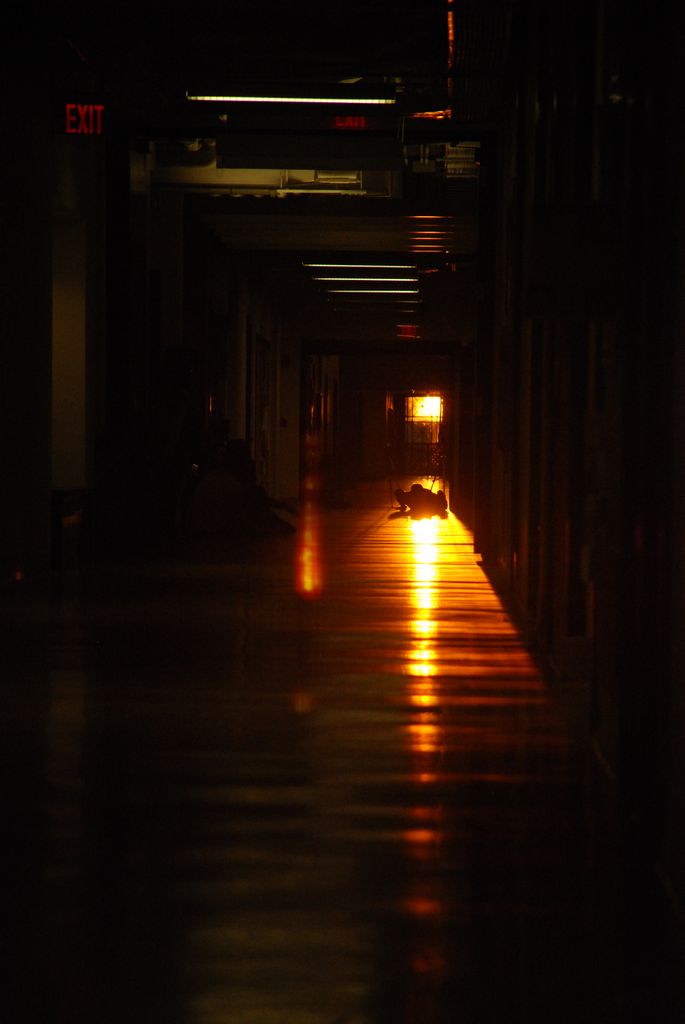
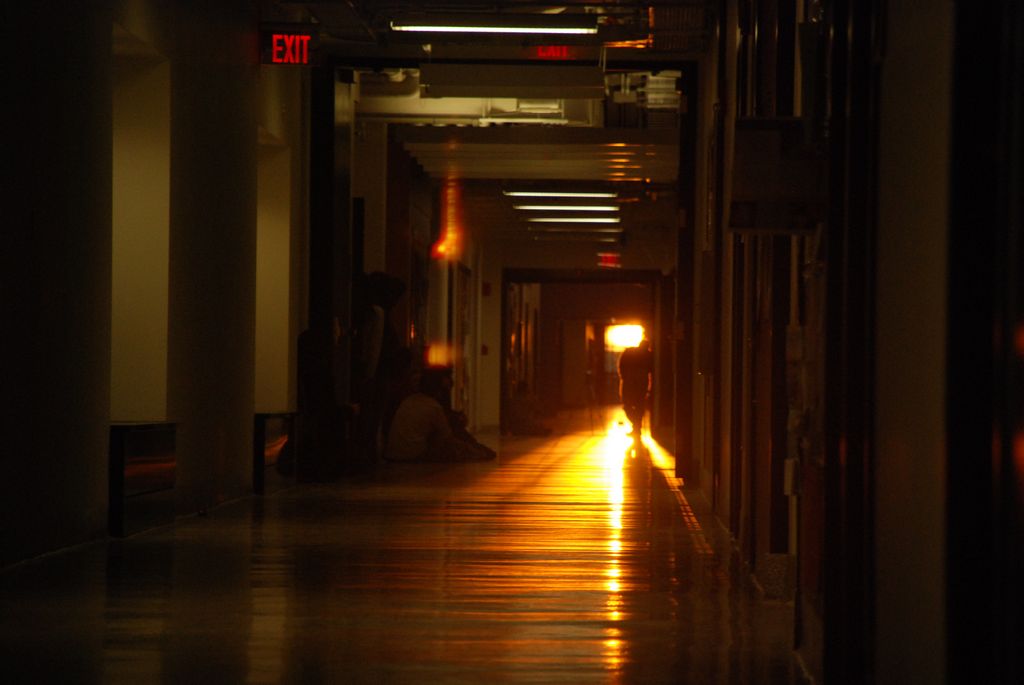
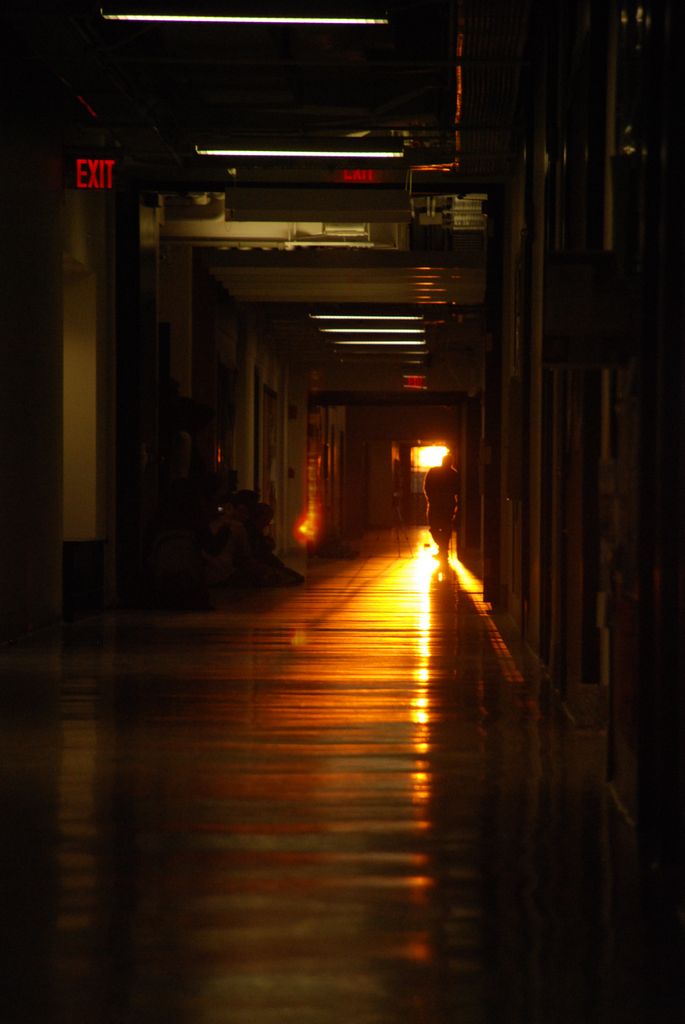
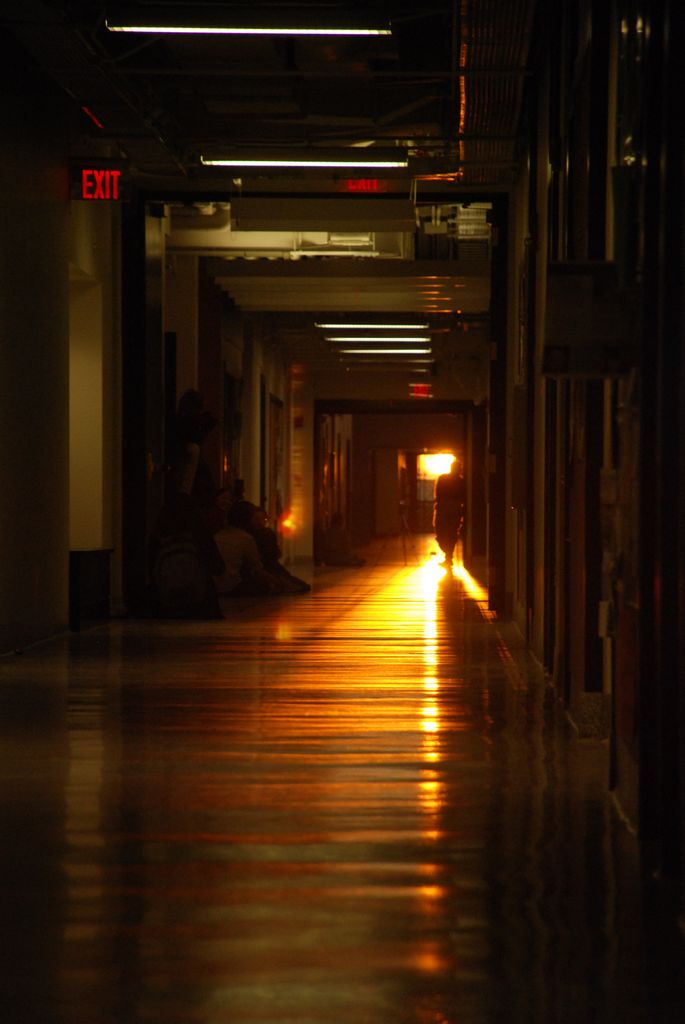
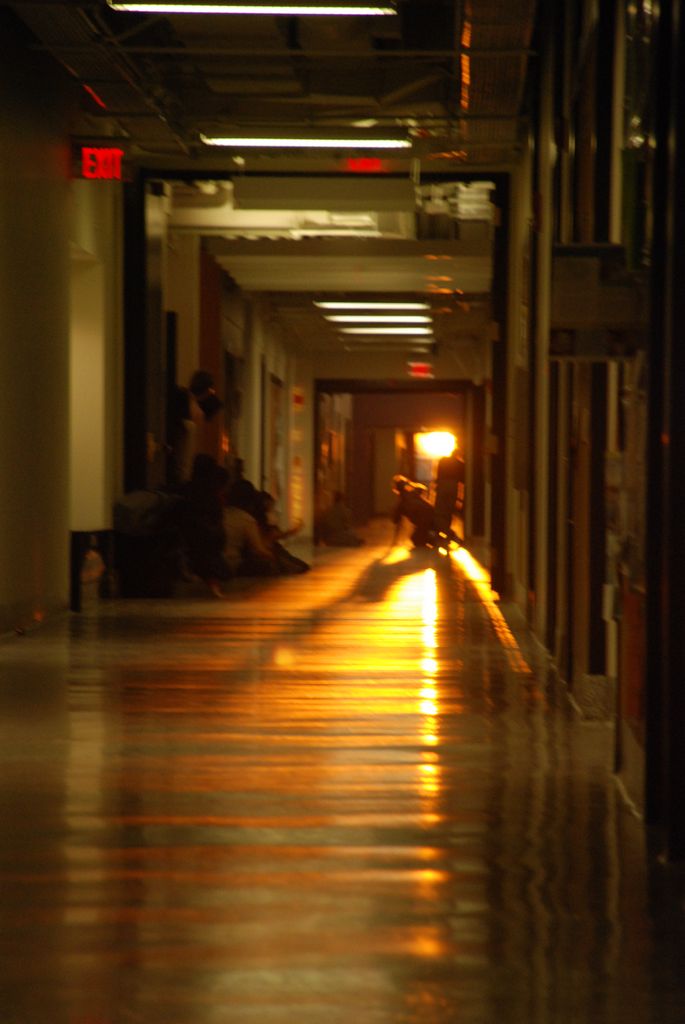
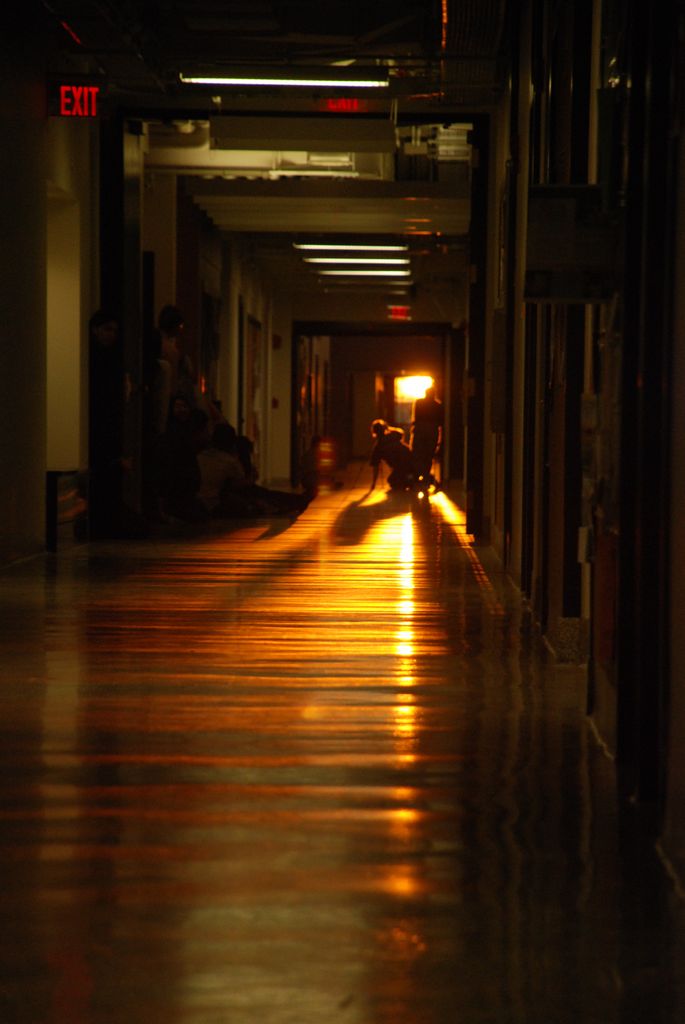
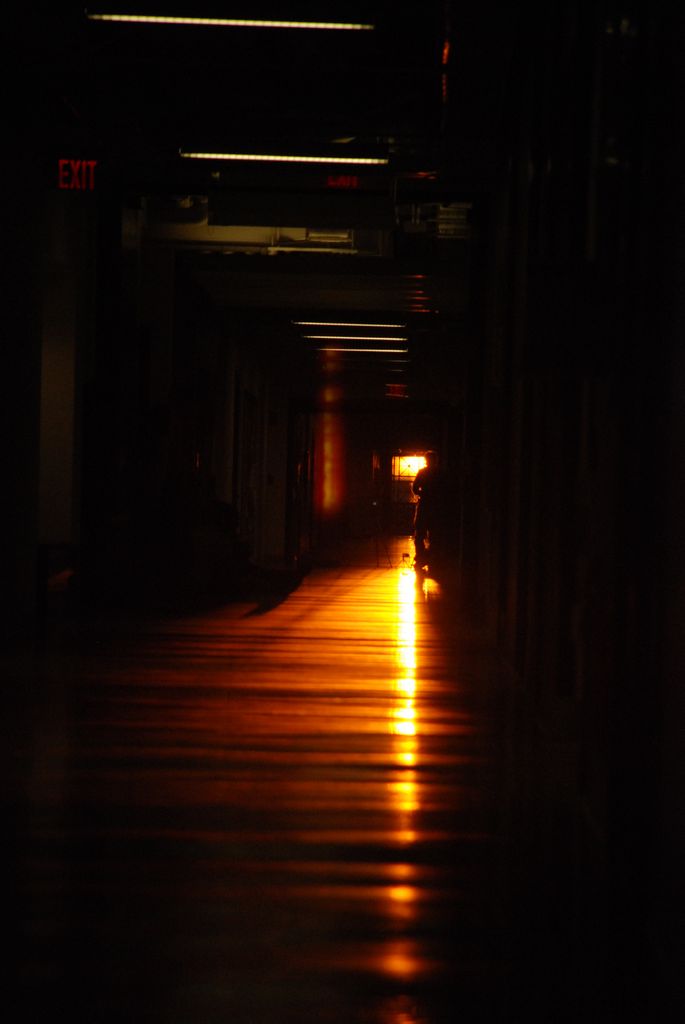
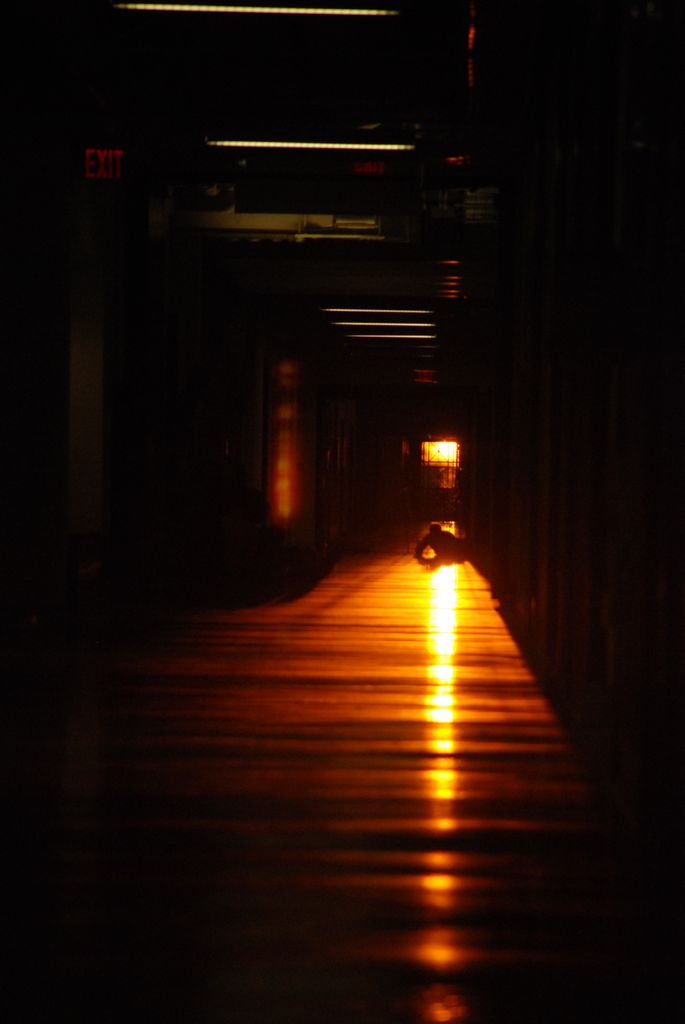
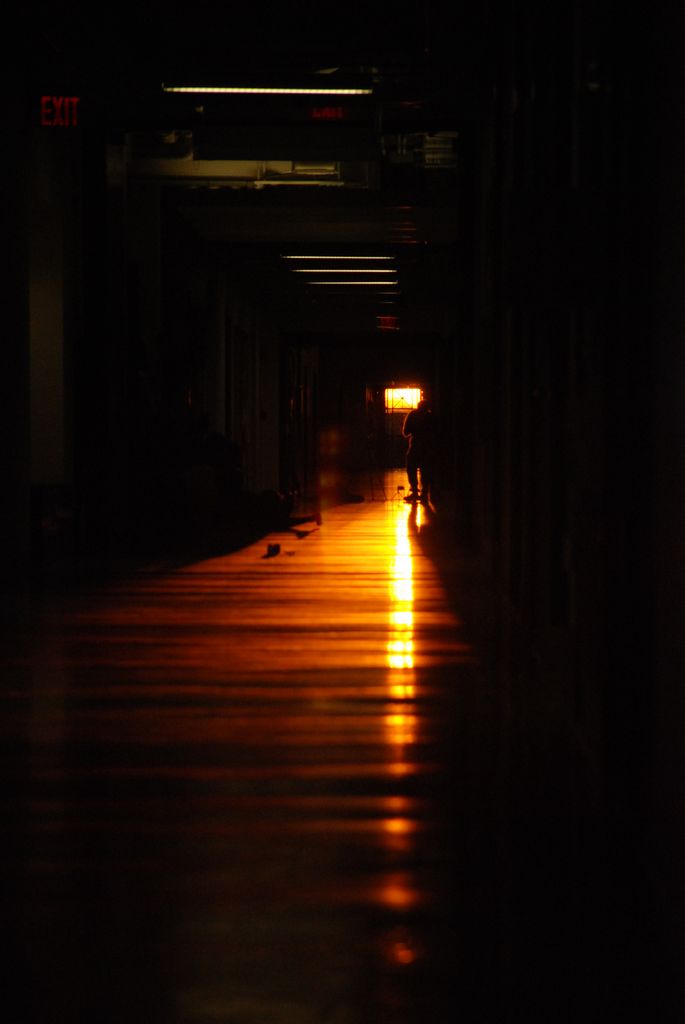
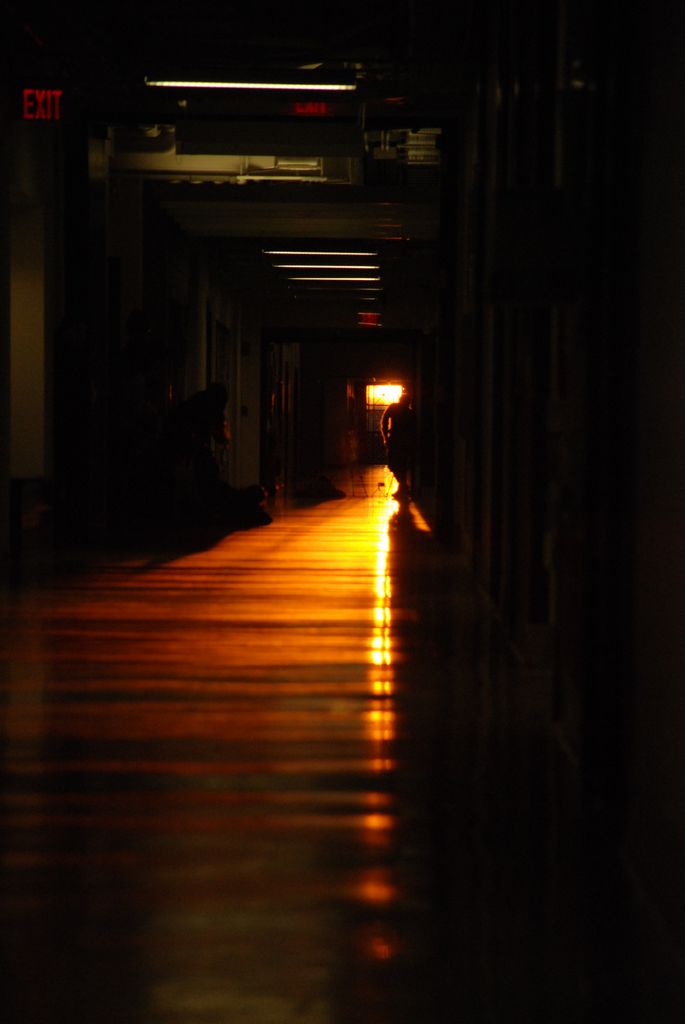
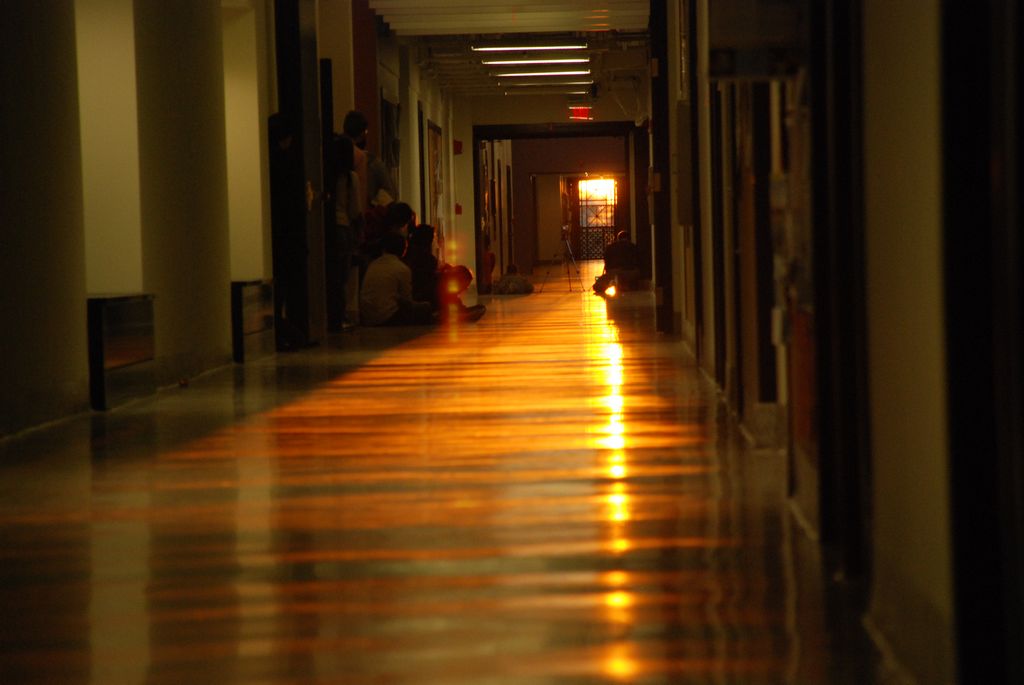
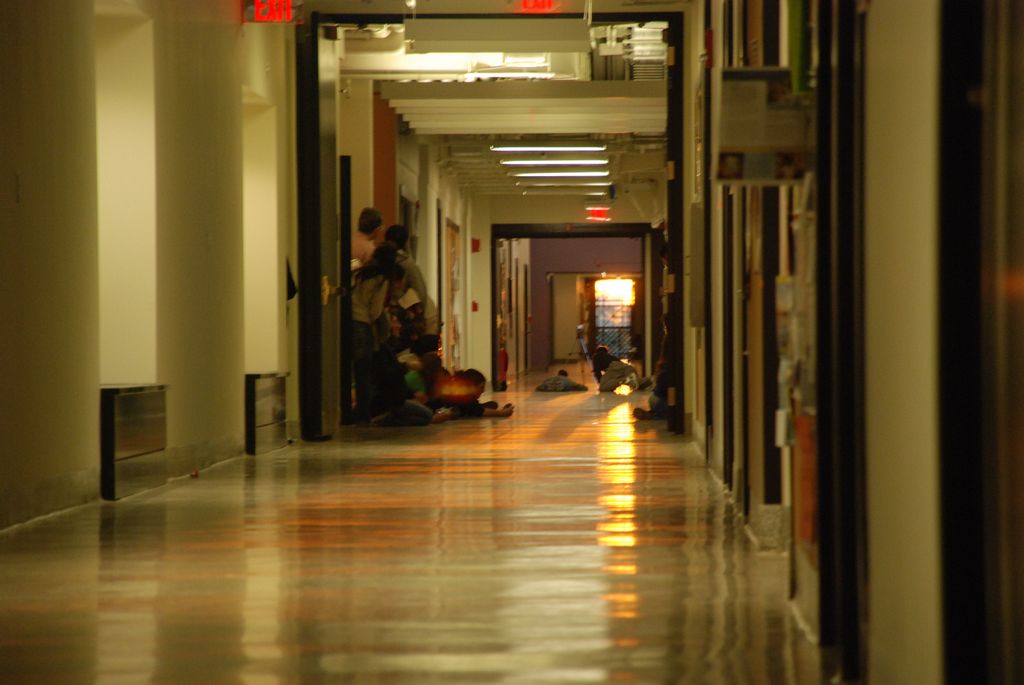
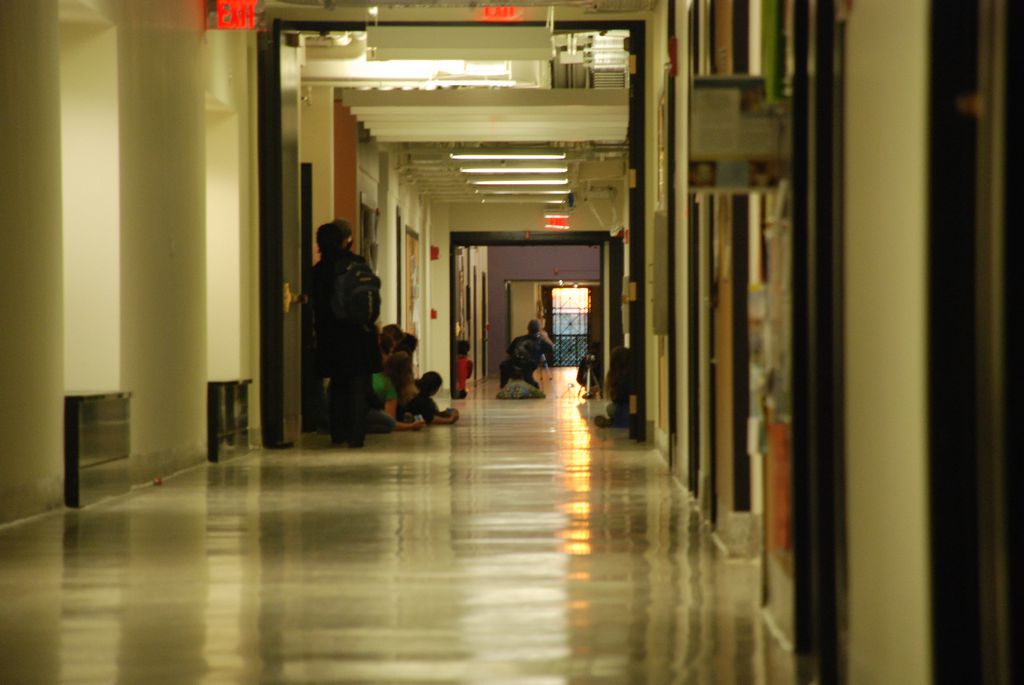
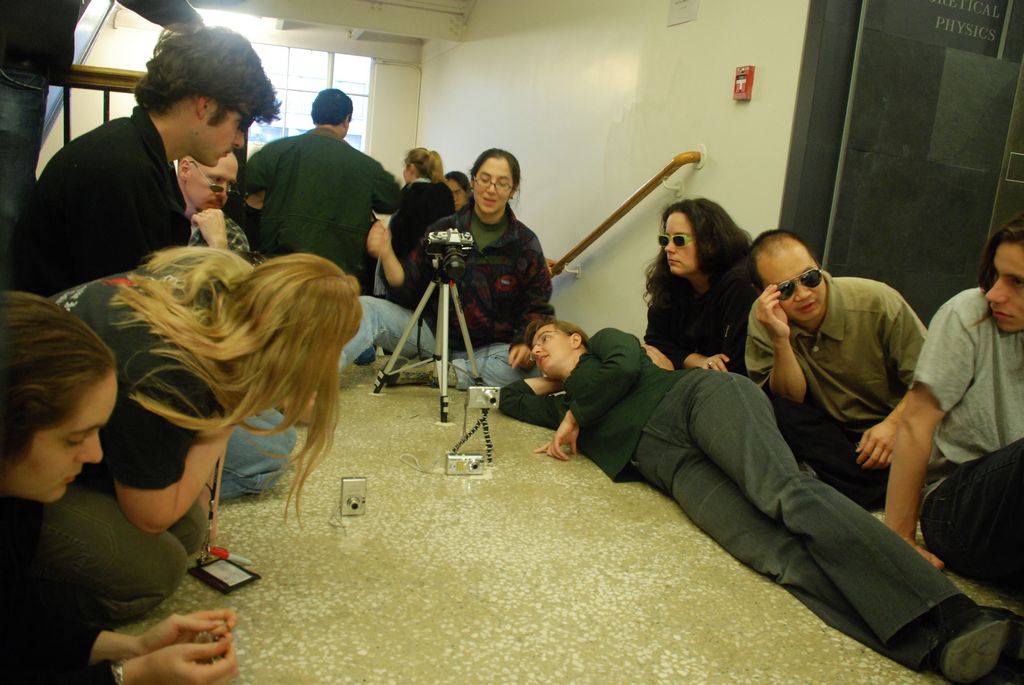
> Dick,
>
> How about creating a charter for the MITHenge Society? Here's a draft
> to spur you on:
>
>
> The MITHenge Society (MITHS) is dedicated to the betterment of
> mankind through a deeper understanding of the MITHenge phenomenon.
>
> Documentation
> - Measure the azimuth of the Infinite corridor
> - Measure the elevation to the horizon
>
> Theoretical
> - Examine the effect of atmospheric refraction
>
> Publication
> - Videos of sun moving by
> - Web page to contain above
> - Real-time video of the next event on the Web
>
> Preservation
> - Work with MIT and the City of Cambridge to maintain a clear view of
> the horizon
>
> Social
> - Examine the causes that lead technically minded persons to find
> this phenomenon fascinating
>
>